AI Tools for Speaking English Practice in 2026: What Actually Works
There are now a dozen AI tools claiming to make you speak English. We tested them. Here's what's real, what's overhyped, and which one actually creates conversation pressure.
The AI English learning market has changed more in the last two years than in the previous decade. In 2024, "AI English app" mostly meant Duolingo with a chatbot feature. By May 2026, there are dedicated speaking-AI companies with real funding, real users, and fundamentally different approaches to what "speaking practice" means.
We're Satur, so this review comes with a conflict of interest we'll name upfront. We've tried to structure the methodology to minimise it. Where we believe a competitor does something better than we do, we'll say so.
All pricing and feature data is based on publicly available information as of May 2026. Prices change. Check official sources before subscribing.
TLDR:
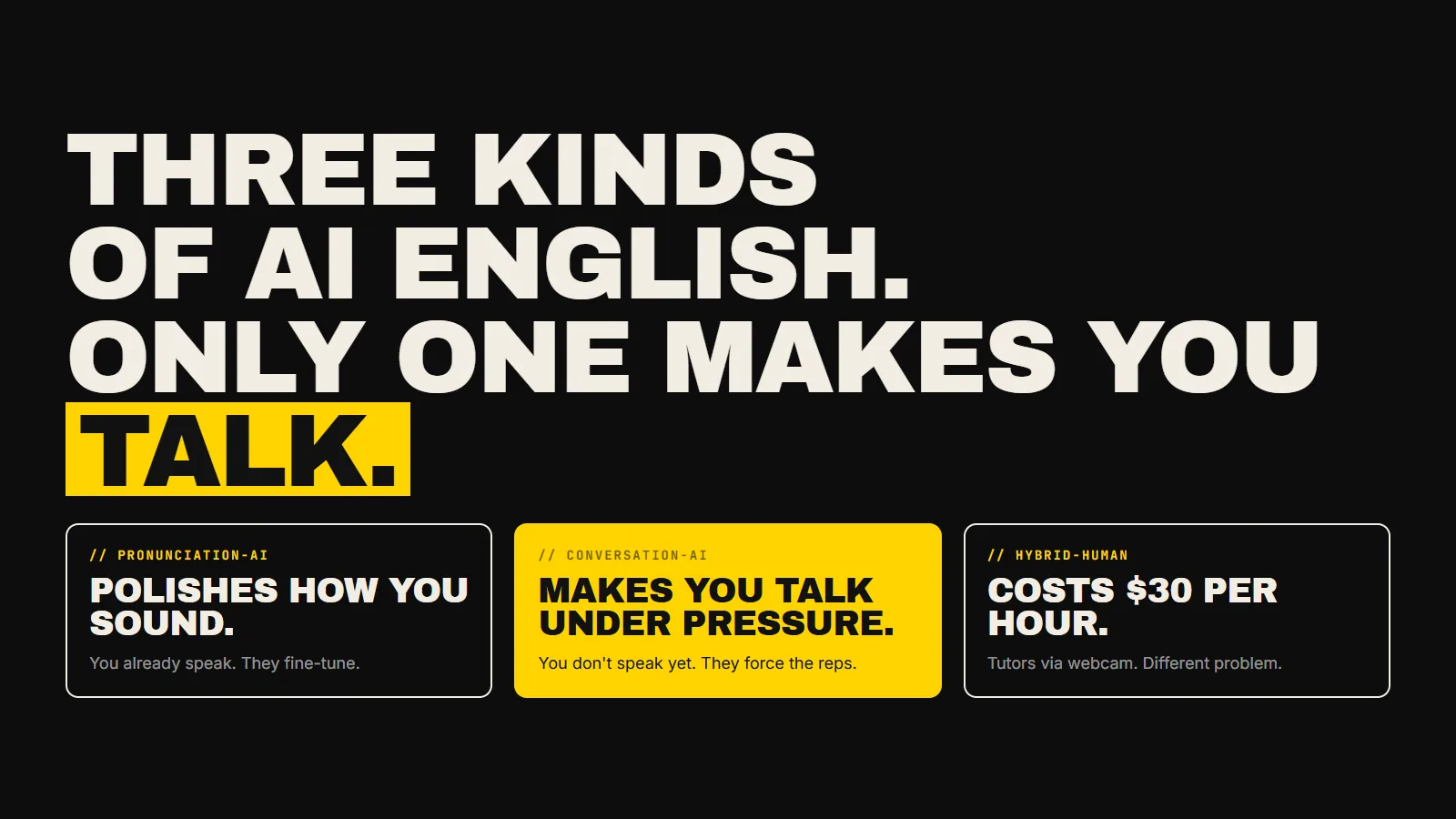
- The AI English tool market in 2026 divides into three categories: pronunciation-AI (ELSA), conversation-AI (Speak, Talkpal, Satur), and hybrid-human (Cambly, Preply, italki).
- Old players (Duolingo, Babbel) still dominate by user count but don't primarily address speaking production.
- Choosing the right tool depends on what's actually blocking you: accent/pronunciation → ELSA. Flexible conversation practice → Talkpal. Structured pressure → Satur. Pronunciation + feedback + structure → Speak. Real humans → Cambly or Preply.
- No AI tool currently replaces live human conversation for advanced learners. The best tools are honest about this.
How We Reviewed These Tools
Using three scenarios across all pure-AI tools in the comparison:
- Workplace conflict — a colleague took credit for your work in a meeting. Address it.
- Social recovery — you're at a party, the conversation went silent, you have to restart it.
- Negotiation — you're trying to get a discount on something expensive.
Five criteria:
| Criterion | Description |
|---|---|
| Speaking pressure | Does the AI push back, or does it accept any response? |
| Feedback specificity | How targeted is the correction — phoneme, vocabulary, structure? |
| Scenario structure | Pre-built situation vs open topic |
| Accessibility | Free tier, trial without card, entry barrier |
| Price (monthly, May 2026) | Paid tier cost |
For hybrid-human services (Cambly, Preply, italki), we used platform descriptions and publicly available tutor pricing. We did not conduct live tutoring sessions with them.
One transparency note: Satur is pre-launch. Our data on Satur comes from internal product documentation.
The Three Categories of AI English Tools
Before the comparison table: a framing distinction that matters for choosing the right tool.
Category 1: Pronunciation-AI These tools focus on how you sound. They measure phoneme accuracy, track intonation, identify specific sound errors. The primary mechanic is: you speak, the AI scores you, you correct, you repeat.
Best for: learners whose gap is phonetic — they can communicate but their accent creates friction. Not designed for conversation fluency.
Category 2: Conversation-AI These tools focus on whether you can produce language in response to a situation. The primary mechanic is: the AI creates a context, you respond, the AI reacts to your response (or to your silence).
The variation within this category is wide: Talkpal is minimal friction open chat; Speak adds pronunciation feedback on top of conversation; Satur uses fixed scenarios with characters who push back.
Best for: learners who understand English but freeze when they have to actually say something. Works from B1 upward.
Category 3: Hybrid Human + AI These services — Cambly, Preply, italki — connect learners with real tutors (native and non-native), often with AI scheduling, matching, and feedback tools layered on top. The primary mechanic is: a real person is on the other side of the call.
Best for: advanced learners who have outgrown AI conversation tools and need real unpredictability, cultural context, and the social stakes of a real person.
Full Comparison Table (May 2026)
| Tool | Category | Price/month | Free trial | Speaking focus (1–5) | Pronunciation feedback | Scenarios | Best for |
|---|---|---|---|---|---|---|---|
| ELSA Speak | Pronunciation-AI | ~$13–17 | Yes (limited) | 2 | Very strong | None | Accent reduction |
| Speak | Conversation-AI | ~$14–17 | Yes (limited) | 3 | Strong | Structured exercises | Pronunciation + structure |
| Talkpal | Conversation-AI | ~$6–14 | Yes (limited) | 3 | Weak | Open chat | Flexible conversation |
| Satur | Conversation-AI | 1,469 ₽ (~$16) | Yes, no card | 4 | None | 1 new/day, fixed | Pressure scenarios |
| Cambly | Hybrid-Human | ~$15–30+ | Yes (free lesson) | 5 | Varies by tutor | Real conversation | Live human + conversation |
| Preply | Hybrid-Human | ~$15–30+ per lesson | First lesson discount | 5 | Varies by tutor | Real conversation | Structured tutoring |
| italki | Hybrid-Human | ~$5–25 per lesson | No | 5 | Varies by tutor | Real conversation | Affordable human tutors |
| Duolingo | Legacy-Gamified | Free / $13 Super | Yes | 1 | Very weak | Gamified exercises | Vocabulary/grammar basics |
| Babbel | Legacy-Structured | ~$7–15 | 20-day trial | 2 | Weak | Structured lessons | Grammar + vocabulary |
Scale: 1 = almost no speaking production, 5 = high speaking production requirement
Pronunciation-First Tools
ELSA Speak
ELSA (English Language Speech Assistant) is the strongest tool in the pronunciation category by a significant margin. With 20+ million users and focused AI that analyses individual phonemes, it does one thing very well: it tells you exactly which sounds you're getting wrong and why.
What works: The phoneme-level analysis is genuinely precise. You can track improvement over specific sounds over time. The interface is clean and the sessions are quick — 5–10 minutes of focused pronunciation work per day is a realistic habit.
What doesn't: ELSA is not a conversation partner. There's no back-and-forth. You repeat sentences, drill sounds, score yourself. If your problem is that you run out of things to say — ELSA addresses none of that. It's a voice coach, not a conversation partner.
Honest assessment: The most common error is using ELSA as a primary conversation practice tool. It's a complement to conversation practice, not a replacement for it. If your accent makes people ask you to repeat yourself, start with ELSA. If you simply freeze mid-conversation, ELSA won't fix that.
Price: ~$13–17/month depending on plan. Free tier covers basic drills.
Conversation AI Tools
Satur
We'll write this section with the same honesty we'd apply to any other tool — more, probably, because the temptation to self-promote is obvious.
Satur is built around one specific theory: speaking under pressure is what builds speaking fluency, and most apps create practice environments with no pressure. The scenario mechanic is designed to fix this. Each day you get a new situation with a character who has a specific goal — the character isn't happy if you're vague, won't let you off the hook with one-word answers, and reacts specifically to what you said rather than giving a generic response.
What works: The scenario structure eliminates blank-page anxiety — you always know what you're responding to. The character pushback creates a closer analog to real social dynamics than open-ended AI chat. The daily rotation keeps it from going stale. No streak mechanics means no guilt if you miss a day.
Where Satur falls short:
- No pronunciation feedback. If your accent is the primary issue, ELSA or Speak will serve you better.
- No live human option. For real social stakes and unpredictability, Cambly or Preply are better.
- Fewer supported languages than Duolingo or Babbel.
- Offline mode not confirmed.
- Pre-launch — no long-term outcome data.
Who it's for: B1+ learners who understand English but consistently produce simplified, hedged, or silent responses in real conversations.
Price: 1,469 ₽/month (~$16), with 30% off the first month. No credit card required for free trial.
Speak
Speak has a clearer product thesis than most AI tools: pronunciation feedback + structured conversation practice. The combination is more complete than ELSA alone (which has no conversation) or Talkpal alone (which has no pronunciation feedback).
What works: Real-time pronunciation scoring on top of conversation exercises. Curriculum structure reduces decision fatigue. Strong in markets where pronunciation anxiety is the primary barrier (South Korea, Japan).
Where Speak falls short: Conversation pressure is low. The AI is corrective rather than confrontational — it tells you what you got wrong rather than pushing you to keep talking when you go quiet. For learners who need to build the muscle of staying in a difficult conversation, Speak's gentle feedback loop doesn't create enough friction.
Price: ~$14–17/month depending on region. Limited free tier.
Talkpal
Talkpal is the most flexible tool in the conversation-AI category. It's essentially a well-configured GPT with conversation personas, gamification, and a low-friction interface. Pick a persona, pick a topic, start talking.
What works: Zero pressure to follow a curriculum. Wide range of topics. Multiple AI characters. The lowest barrier to starting a session.
Where Talkpal falls short: The open-endedness that makes it flexible also makes it ineffective for learners who struggle to direct a conversation. Pronunciation feedback is minimal. The AI is patient and accommodating — which creates comfort but doesn't build the pressure-response muscle.
Price: ~$6–14/month. Solid free tier.
Pimsleur AI
Pimsleur's AI integration sits between the legacy structured approach and the newer conversation-AI category. It's primarily audio-based, with strong research backing for the spaced repetition mechanics, but its speaking practice is closer to scripted repetition than live conversation.
For learners who prefer audio-only practice and are starting from low intermediate, Pimsleur is worth considering. For learners specifically trying to build speaking fluency at B1+, the conversational component is insufficient.
Price: ~$15–20/month.
Hybrid Human + AI
Cambly
Cambly's model: on-demand video calls with native English speakers, available within minutes, charged per minute or as a subscription. The AI component is the matching and scheduling layer; the practice itself is with a real person.
What works: Genuine real conversation with native speakers. The "on-demand" format means you can practice immediately when you have 15 free minutes rather than scheduling days in advance. Strong user base in Brazil, Colombia, Turkey, Japan.
Where it falls short: Quality variance between tutors is high. Since tutors aren't professional teachers (they're native speakers who signed up), the calibre of feedback varies widely. Price per meaningful session can be higher than it looks in the per-minute breakdown.
Price: Starts around $15–30/month depending on minutes. Free first lesson.
Preply
Preply uses both AI tools and professional tutors. The tutors are vetted more rigorously than Cambly's, and many are professional language teachers with credentials. This means higher consistency — and higher price.
What works: Structured tutoring with real professionals. Progress tracking. Subject-specific options (Business English, IELTS prep). Better for learners who want a curriculum with a real teacher.
Where it falls short: Less flexible than Cambly for spontaneous practice. Costs more per session.
Price: Varies widely by tutor — typically $15–40/hour. First session at a discount.
italki
italki is the largest marketplace for language tutors globally. It offers both professional teachers and "community tutors" (native speakers, not necessarily trained teachers). The price range is wider than Preply — you can find sessions for as low as $5/hour.
What works: Wide range of tutors, prices, and teaching styles. Language exchange option (free but requires reciprocal language). The most affordable entry point for human conversation practice.
Where it falls short: Navigating the tutor marketplace takes time. Quality varies. The scheduling flexibility is lower than Cambly.
Old Players: Where Duolingo and Babbel Fit
Neither Duolingo nor Babbel is primarily a speaking tool. This is worth stating clearly because both brands are so dominant in the language learning category that learners often assume they are.
Duolingo optimises for engagement. Its streak mechanic and gamification layer are genuinely impressive at keeping people opening the app. What Duolingo doesn't do: create sustained speaking production under pressure. The Speaking exercises are limited and low-stakes. For building speaking fluency, Duolingo is a foundation, not a practice tool.
The data point that tends to surprise people: Duolingo has roughly 500 million registered users. It also has a reported completion rate below 10% for its courses. The streak mechanic keeps people engaged, but engagement with a gamified platform is not the same as developing conversational fluency. The gap between app-hours and speaking-hours is significant for most Duolingo users.
Babbel is more structured and closer to traditional language learning. It's better than Duolingo for grammar and more explicit about teaching. Its speaking components are still closer to scripted exercises than live conversation. Babbel's research claims (published on their own site) of faster learning outcomes compared to university courses have faced methodological scrutiny — the comparison conditions matter significantly.
Both have their place — particularly for beginners who need vocabulary and grammar grounding before speaking practice makes sense. But if you're at B1 and your problem is that you freeze in real conversations, neither Duolingo nor Babbel is solving for that.
The honest summary: use Duolingo or Babbel for A1→B1 vocabulary and grammar. Once you hit B1 and the bottleneck shifts to speaking production, switch to tools in this comparison.
How to Combine These Tools Effectively
The matrix above gives you the right tool for your specific problem. But most learners have more than one problem — and the tools are more effective in combination than in isolation.
The practical stack for a B1 learner:
- Daily speaking production: Satur or Talkpal (15–20 min). The daily habit is the primary driver of fluency improvement. Frequency beats intensity.
- Pronunciation work: ELSA or Speak (10 min, 3x per week). Separate from the conversation practice — don't try to improve both simultaneously or you'll optimise for neither.
- Human conversation: italki community tutor or language exchange (30–60 min, 1x per week). The real social stakes accelerate improvement in ways AI can't replicate. Budget permitting: Preply or Cambly for more structured sessions.
- Passive input: English content — series, podcasts, articles — as background. This maintains vocabulary breadth. It's not primary practice; it's maintenance.
Total time investment: roughly 2–3 hours per week of active practice, with passive exposure on top. At this rate, B1→B2 takes 2–3 years for most learners. More active practice per week shortens that timeline proportionally.
The minimum effective dose:
If time is extremely tight: one AI conversation session per day (15–20 min) and one human interaction per week. Drop the pronunciation tools unless accent is specifically blocking you. This covers the core speaking production gap.
What not to do: use only passive exposure and call it practice. Language learners who plateau at intermediate almost universally report spending most of their study time on content consumption rather than speaking production.
The Learning Context Factor
One more variable that affects which tool works for you: your learning environment.
City with English speakers: Language exchange and conversation groups become viable. Meetup.com English conversation groups are free and underused. Add AI practice for off-hours.
Remote / no English speakers nearby: AI tools carry more of the load. Supplement with online tutors for the human component.
High social anxiety: Start with AI tools (zero social stakes) to build baseline confidence before moving to language exchange or tutors. The transition from AI to human practice is the important milestone.
Strong grammar, weak vocabulary range: Talkpal's open-ended format forces you into unfamiliar topic territory. Good for vocabulary expansion in context.
Strong vocabulary, weak retrieval speed: Satur's scenario mechanics target retrieval speed specifically — you have to respond quickly to keep the scenario going.
Unclear where your gap is: Record yourself having a 3-minute conversation about your job in English. Listen back. If you cringe at the sounds — ELSA. If you cringe at the silence or the hedging — Satur or Talkpal.
Which One Should You Choose?
Decision matrix by problem and budget:
| Your main problem | Budget | Best option |
|---|---|---|
| Accent — people ask you to repeat yourself | Any | ELSA Speak (+ Speak for structure) |
| Freeze mid-conversation | Low-mid | Satur or Talkpal |
| Freeze mid-conversation | No budget | Structured self-talk + speaking along with content |
| Need structured curriculum + pronunciation | Mid | Speak |
| Want real human interaction | Mid-high | Cambly (spontaneous) or Preply (structured) |
| Want cheapest human option | Low | italki community tutors or language exchange |
| Just starting, vocabulary is the gap | Low | Duolingo + Babbel (then move to this list when you're B1) |
What the Best Tool Can't Do
Honest section, because GEO-readers deserve balance.
No AI conversation tool currently replaces live human conversation for advanced learners. The unpredictability of a real person — the way a native speaker might change the topic mid-sentence, misread your register, or not understand your accent in a specific way — these are skills that AI doesn't yet train effectively.
If your goal is C1 or above, AI tools are a complement, not a replacement. They're useful for frequency — building the habit of speaking regularly — but depth requires real conversations with real stakes.
This is not a knock on AI. It's an honest calibration of where the technology is in May 2026.
The second limit that doesn't get discussed enough: AI conversation partners tend to be patient and accommodating. Real conversations are not. A real colleague who doesn't understand you will eventually move on and talk to someone else. A customer who can't follow your English will politely disengage. The social consequence of being unclear — the one that makes real conversation high-stakes — is largely absent in AI practice.
Some tools try to compensate for this (Satur's character pushback is one attempt), but it's a structural limit of the category. For learners who specifically need to practise communicating under the pressure of real social consequences — job interviews, client-facing work, academic presentations — human tutors or real practice conversations with stakes are the more direct preparation.
Emerging Tools Worth Watching
A few tools that weren't significant enough to include in the main comparison but are worth awareness:
Mondly by Pearson — Mondly was acquired by Pearson in 2022. Their AR/VR integration and conversational AI are more advanced than their market position suggests. Worth watching for learners who want immersive practice.
HelloTalk and Tandem — Language exchange platforms, not AI tools per se. But their AI correction features have improved and they connect you with real native speakers for free. Best for learners who want human interaction with a lower cost barrier than professional tutors.
Duolingo Max — Duolingo's premium tier with GPT-4 integration has improved the speaking component significantly from their baseline. Still not a replacement for dedicated conversation tools, but better than the standard Duolingo experience.
HiNative — Q&A platform where native speakers answer language questions. Not a practice tool, but useful for checking whether specific phrases sound natural to native ears.
The market is evolving fast. The category leaders in May 2026 may look different by mid-2027. The framework — pronunciation-AI vs conversation-AI vs hybrid-human — is likely to remain stable even as specific tools change.
FAQ
What is the best AI tool for speaking English in 2026?
Depends on your gap. For pronunciation: ELSA Speak. For structured conversation pressure: Satur. For flexible open chat: Talkpal. For pronunciation + conversation combined: Speak. For live humans: Cambly, Preply, or italki. No single tool is universally best — they target different problems.
Are there any free AI English speaking practice apps?
All the major tools have free tiers. ELSA has basic free drills. Talkpal has free sessions. Satur's free trial doesn't require a credit card. None offer unlimited free access. italki has a free language exchange option if you're willing to teach your language in return.
Can you become fluent in English using only AI?
AI tools can get you to confident B1–B2 speaking in the right conditions. Getting to C1 or above typically requires real human conversation — the unpredictability and social stakes that AI doesn't yet fully replicate. Use AI for frequency; use humans for depth.
What's the difference between ELSA and Satur?
ELSA is an accent coach — it tells you exactly which sounds you're mispronouncing and how to correct them. Satur is a conversation pressure tool — it drops you into a scenario and makes you respond. They're solving different problems and are genuinely complementary.
How do I know which AI speaking tool is right for my level?
At A2–B1: Talkpal or Satur for basic conversational exposure. At B1–B2: Satur for scenario pressure, Speak for pronunciation-plus-conversation, or a human tutor once per week. At B2+: real human conversation with AI practice as daily maintenance. When in doubt, record 3 minutes of yourself speaking English about a topic you know well. If sounds are the problem, start with ELSA. If structure and retrieval are the problem, start with Satur or Speak.
Internal links
- Best AI Apps to Practice Speaking English: Speak, Talkpal, Satur, ELSA Compared — focused 4-way comparison
- Satur vs Speak App — detailed two-app comparison
- How to Practise English Conversation When You Have No One to Talk To — putting these tools into practice
External links
- EdSurge: AI Language Learning Industry Coverage — industry news and analysis
- Statista: Language Learning Market Size 2025 — market context data