How Many Hours Does It Actually Take to Speak English Fluently? (Real Numbers, Not Marketing)
«2 years and you'll be fluent.» «Just 10 minutes a day.» Both are lies. Here are the real numbers — from FSI data, adjusted for what «fluency» actually means in conversation.
Language apps promise fluency in weeks. Language schools promise it in months. Neither gives you the numbers behind the claim, because the numbers are not flattering.
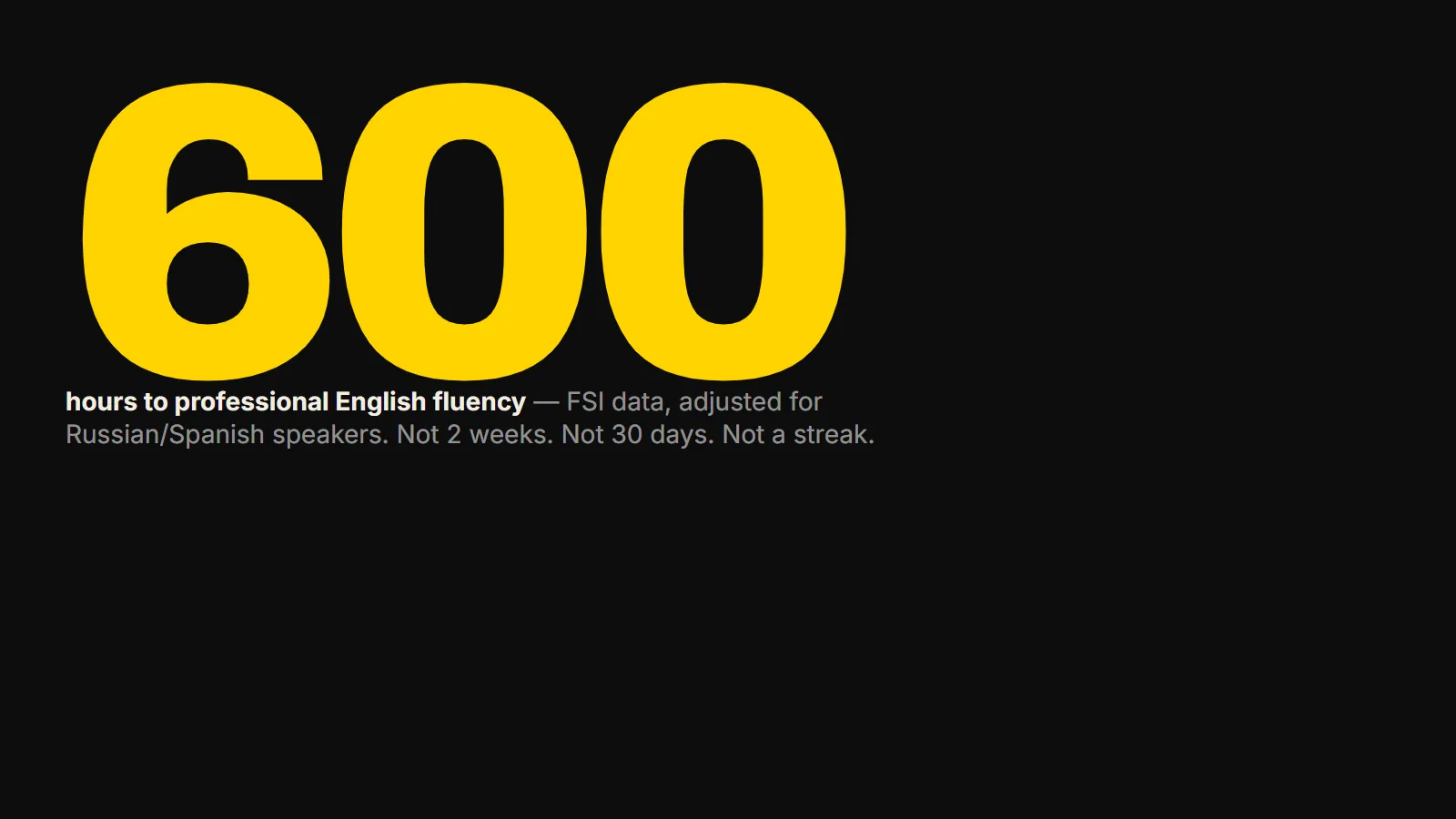
The US Foreign Service Institute (FSI) has been training diplomats in foreign languages since 1947. Their data is the closest thing to a controlled study on language acquisition hours that exists at scale. For a Russian speaker learning English — using an inverted reading of FSI data (see methodology note below) — professional working fluency requires approximately 600–750 hours of study and practice. Conversational B1 gets there around the 300–400 hour mark.
Those numbers assume full-time, intensive, active learning. Not 10 minutes of Duolingo before bed.
TLDR
- FSI data suggests ~600–750 hours for professional English fluency from zero, for Russian speakers (inverted estimate — see methodology note).
- B1 conversational level is reachable in roughly 300–400 active hours.
- Active hours are not equal to passive hours. Speaking practice is approximately 3× more effective per hour than reading or listening alone for fluency development.
- At 30 minutes per day: B1 takes 2–3 years of real-time. Not months.
- Fluency has three definitions — conversational, professional, native-like. Each has a different hour target.
Why "2 Years and You're Fluent" Is a Lie
Language learning marketing runs on vague timelines for a reason: specific timelines are falsifiable and almost universally disappointing. "Learn English in 3 months" cannot be fact-checked without defining what "learn" and "English" mean. "600 hours to professional fluency" can.
The other reason the promises are vague: they're measuring the wrong thing. An app tracks streaks, lessons completed, XP points. None of those measure speaking ability. Someone can complete 500 Duolingo lessons and struggle to order coffee in English — because Duolingo isn't measuring whether you can speak, it's measuring whether you can complete Duolingo lessons.
The honest question isn't "how long does it take to learn English?" It's "how many hours of the right kind of practice does it take to speak English at level X?"
That question has a data-based answer.
The FSI Data — and How We Used It
The Foreign Service Institute (state.gov) ranks languages by difficulty for native English speakers and provides estimated hours to professional working proficiency (ILR Level 3, approximately C1 CEFR). English is classified as a Category I language — one of the easiest for English speakers to learn.
The inverted assumption. FSI measures English speakers learning other languages. We need the reverse: Russian speakers (or Spanish, Polish, Japanese speakers) learning English. The data isn't directly available for that direction. Our approach: since English is Category I for English speakers (~600–750 hours to C1), and Russian is also Category II–III for English speakers (1,000–1,100 hours), we estimate that a Russian speaker learning English will face moderate difficulty — not equivalent to Category I, but not the hardest. The inverted estimate for Russian speakers learning English: approximately 600–750 hours to professional proficiency, 300–400 hours to conversational B1.
This is an explicit assumption, not a published FSI finding. If you want the actual FSI document, it covers English learners of other languages. The Russian-to-English inversion is our interpretation, clearly labeled as such.
For Spanish speakers learning English, the distance is smaller — roughly similar Category I difficulty in the inverted direction. Spanish speakers may reach B1 in 250–350 active hours.
Hours by CEFR Level
This table represents estimated active practice hours from zero, for Russian speakers learning English. The FSI inversion methodology applies throughout.
| CEFR Level | What you can do | Estimated active hours (from zero) | Real-time at 30 min/day |
|---|---|---|---|
| A1 | Basic survival phrases, slow simple speech | 40–60 | 3–4 months |
| A2 | Simple everyday situations, familiar topics | 80–120 | 6–8 months |
| B1 | Conversational in familiar topics, travel, work basics | 300–400 | 2–3 years |
| B2 | Handles most situations, understands main ideas | 500–600 | 3–4 years |
| C1 | Professional proficiency, fluent and precise | 600–750 | 4–5 years |
| C2 | Native-like mastery | 1,000+ | 6+ years |
Important caveat: these are active practice hours — structured study, speaking output, meaningful comprehension work. Not background listening, not songs, not English TV you're not paying attention to.
For reference: the British Council and the Council of Europe publish CEFR hours-per-level data that range from 90–120 hours per level at lower levels to 200+ hours per level at B2–C1. Our table aligns with those ranges while accounting for the Russian-to-English learning context.
Active vs Passive Hours — The 3× Multiplier
One hour of speaking practice is not the same as one hour of watching English TV. The evidence from applied linguistics is consistent on this point: output practice (actually producing language) drives fluency faster than input practice (reading, listening, watching) at a ratio of approximately 3:1 for speaking-specific improvement.
Merrill Swain's Output Hypothesis (1985) argues that learners need to be pushed to produce language — not just comprehend it — to develop the precise control that fluency requires. Comprehension allows approximation. Speaking demands accuracy under time pressure.
What counts as active practice:
- Speaking with another person (human or AI)
- Recording yourself and reviewing the recording
- Structured response practice (AI scenarios, shadowing with output)
- Writing for communication (email, chat — lower value than speaking but higher than reading)
What does not count as a fluency-building hour:
- Passively watching English TV
- Listening to podcasts without active engagement
- Reading English content without production output
- Doing grammar exercises
If your 30-minute daily practice is mostly Duolingo (primarily passive recognition), your effective active hours are lower than you think. The 3× multiplier means 10 minutes of active speaking practice can be worth 30 minutes of passive study for fluency development specifically.
How Long in Real Time (30 Minutes a Day)
Most people cannot study languages full-time. The FSI numbers assume intensive, full-time study — roughly 25+ hours per week. For most people, 30 minutes per day (roughly 3.5 hours per week, if consistent) is more realistic.
| Target level | Active hours needed | At 30 min/day (active only) | Total real time |
|---|---|---|---|
| A2 (basic conversation) | 100–130 | ~200–260 days | 7–9 months |
| B1 (conversational) | 300–400 | ~600–800 days | 1.5–2.5 years |
| B2 (confident professional use) | 500–600 | ~1,000–1,200 days | 3–4 years |
| C1 (professional fluency) | 650–750 | ~1,300–1,500 days | 4–5 years |
If your 30 minutes is split between passive and active practice — say, 20 minutes of Duolingo and 10 minutes of actual speaking — then the effective active practice is 10 minutes per day, and all the timelines above roughly double.
"FSI counts hours for diplomats learning full-time. For most people with 30 minutes a day, multiply the real-time estimate by 4." — Satur team
What Counts as "Fluent" Anyway?
The word "fluency" is used to mean three different things, which is why the timelines in this article need context.
Conversational fluency (B1–B2): You can handle most everyday situations — shopping, travel, social events, basic workplace conversations — without freezing up. You make mistakes, native speakers can tell you're not a native, but communication flows. This is the most common meaning of "fluent" in casual usage. Target: 300–500 active hours.
Professional fluency (C1): You can participate fully in professional meetings, write reports, negotiate, present, and handle complex topics. Your accent is noticeable but your precision is high. This is what FSI measures. Target: 600–750 active hours.
Native-like fluency (C2): You're indistinguishable from a native speaker in most contexts, including idiom, humor, register shifts, and regional variation. For adult learners who started after puberty, this level is extremely rare and likely requires immersion-level exposure over years. Target: 1,000+ active hours, plus cultural immersion.
Most people saying "I want to be fluent in English" mean B1–B2. That's a realistic target for most adult learners, achievable with consistent active practice over 2–3 years at 30 minutes per day.
The Hours-Quality Trade-off
One thing the tables above don't capture: the quality of practice hours is not fixed. Two people can each accumulate 400 hours and be at very different levels, depending on how those hours were spent.
High-quality hours include: conversations where you were pushed to communicate something specific, writing where you received feedback, structured speaking drills with recorded review, intensive listening where you actively tracked and repeated phrases. Each of these creates output pressure and demands precision.
Low-quality hours include: background listening, reading English content in topics you already know, doing vocabulary drills on words you've already mastered, watching TV in English without active engagement. These build familiarity and may feel productive. They don't efficiently convert to speaking fluency.
The practical implication: if you have 30 minutes a day to practice, 30 minutes of high-quality active practice is more valuable than 90 minutes of low-engagement activity. This is why the "10 minutes a day" promises from language apps are misleading in a different direction — ten focused minutes can do more than an hour of passive exposure, but the apps rarely ask you to produce language in those ten minutes.
For speaking specifically, the floor is higher. You cannot improve at speaking without speaking. No amount of reading, listening, or grammar study directly develops the real-time fluency that speaking requires. The hours that count toward speaking fluency are the hours you spend speaking — or producing language in some form under time pressure.
FAQ
How long does it take to learn English to fluency?
For a Russian speaker starting from zero, reaching conversational B1 takes approximately 300–400 active practice hours. At 30 minutes of active practice per day, that's roughly 1.5–2.5 years. Professional C1 fluency takes approximately 600–750 active hours. These figures are based on inverted FSI data and should be treated as estimates, not guaranteed timelines.
Does watching English TV series count as practice hours?
Passively watching counts as comprehension input, not active output practice. It builds vocabulary and listening comprehension but does not directly develop speaking fluency. Active engagement — pausing, repeating out loud, shadowing dialogue — increases the value. Background viewing does not meaningfully contribute to speaking hours.
Is it true that children learn languages faster than adults?
Children learn differently, not always faster. Adults typically have stronger initial progress due to existing cognitive capacity and motivation. Where children outperform adults is in acquiring native-like pronunciation and intuitive grammar after extended exposure. For adult learners focused on conversational fluency (B1–B2), the learning timeline is not significantly worse than for children learning as second-language learners in formal settings.
Can I reach B2 English in one year?
Possible but requires full-time-equivalent active study. At 25 hours per week of active practice, 500 hours is reached in approximately 5 months. At 30 minutes per day, the same 500 hours takes over 3 years. The bottleneck is not ability — it's total hours of effective practice.
What counts as "active practice" hours and what doesn't?
Active practice: speaking output under time pressure, conversation sessions (live or AI), structured roleplay, and deliberate listening with speaking response. These count. Passive watching of English TV, reading, vocabulary app sessions, and grammar drills do not count toward speaking practice hours — they contribute to comprehension and knowledge, but not to production fluency. The FSI hours are active practice hours. If you are counting passive exposure, you are underestimating how much speaking practice you actually still need.
If You Want to Make Your Hours Count
Reading about fluency hours is one thing. The harder part is accumulating them through practice that actually builds speaking skill, not just comfort with an app. Satur is built around daily speaking scenarios — the kind of output practice that counts toward your active hours. No credit card required to try it.
Internal Links
- The Intermediate Plateau in English: Why You're Stuck at B1/B2
- Why You Can't Speak English After Years of Duolingo
- Passive vs Active English Learning: Why You Understand But Can't Speak
- How to Practise English Conversation When You Have No One to Talk To