Open English vs Satur: An Honest 2026 Comparison for Real Speaking Practice
Open English costs $80–120/month for live teachers on schedule. Satur is ~$15/month AI scenarios on demand. Two different products. Here's an honest side-by-side.
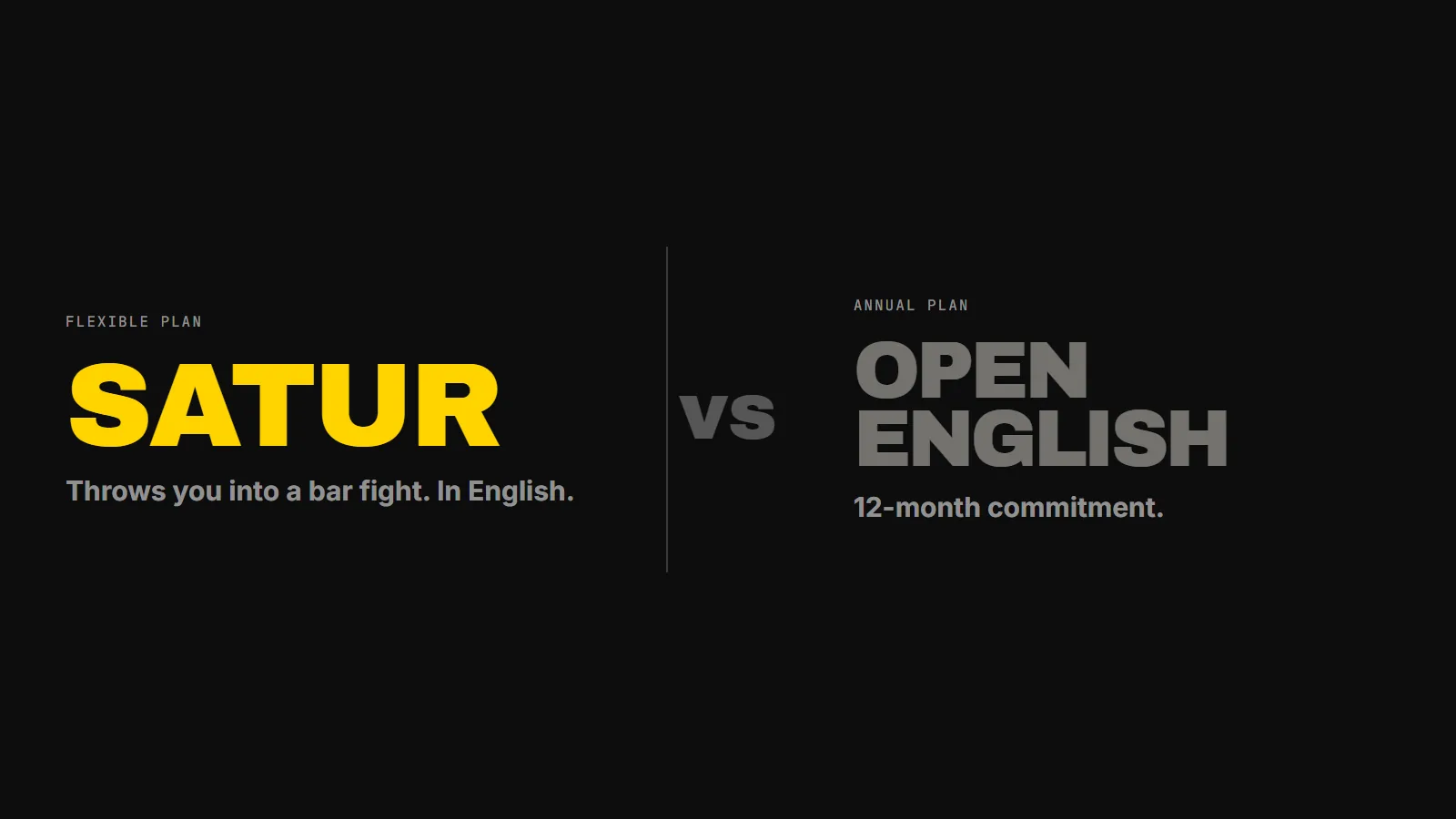
Open English has been around since 2007, dominant in Latin America, and built around live classes with native English teachers on a scheduled basis. Satur is a 2026 AI conversation app priced around $15/month, no schedule required.
They are different products for different needs. This comparison won't pretend one is universally better.
TLDR
- Open English = live native teachers, scheduled classes, structured curriculum. Strong for those who need human accountability. Costs $80–120/month with annual contract.
- Satur = AI conversation partner with scenario-based pressure. Available 24/7, no contract, no credit card to try. ~$15/month.
- They don't compete in the same space. Open English is closer to a digital language school. Satur is closer to a speaking gym.
- Comparison table below. Verdict by user profile at the end.
Two Very Different Models
Open English's value proposition is the live teacher. Real humans, native speakers, available across multiple time zones. The curriculum is structured by level. You schedule classes, you attend them, the teacher adapts to your needs in real time.
Satur's value proposition is the daily speaking scenario. The AI plays a character with a specific goal. You navigate a situation — a complaint conversation, a difficult coworker, a bar negotiation — using English. The AI pushes back if you hedge. No schedule, no teacher, no curriculum in the traditional sense.
These are different philosophical bets about what creates speaking improvement. Open English bets on human guidance and structure. Satur bets on daily frequency under pressure with low friction.
Comparison Table
| Criterion | Open English | Satur |
|---|---|---|
| Model | Live classes with native teachers | AI conversation with scenarios |
| Monthly price | ~$80–120 (varies by plan and country) | ~$15 |
| Free trial | Limited demo / paid trial | Free, no credit card |
| Schedule | Scheduled classes (commitment required) | 24/7, on demand |
| Interaction | Real human (native teacher) | AI character with personality |
| Cancellation | Contract; 2-month penalty after 7-day trial | No commitment |
| Best for | Structure + human presence + basic/intermediate level | Daily speaking practice, A1–C1 |
Prices based on publicly available information as of May 2026. Open English varies by market.
What Open English Does Well — and What It Doesn't
Open English's main strength: live access to native English teachers across flexible time zones. For many learners, that's exactly what they need — a real person who corrects, explains, and adapts the lesson to your specific question. Human interaction has value that no AI has fully replicated yet.
The platform includes study materials, progress tracking, and customer support. If you're someone who needs structure and formal commitment to learn, Open English provides that.
What it doesn't do as well: the price is the most commonly cited friction point in public reviews. Plans can exceed $100/month, with annual commitments in many markets. For many learners, that's not sustainable.
Classes are scheduled. If your week is unpredictable — irregular work, travel, kids — meeting the schedule can become more stressful than the English itself. Cancellations frequently mean reduced value.
Classes follow a curriculum. The teacher adapts, but within a program. You practice the lesson, not the conversation you'll need tomorrow at work.
What Satur Does Well — and What It Doesn't
Satur is built around a specific diagnosis: people study English for years and then freeze when it's time to actually speak. The AI generates scenarios with real pressure — situations where you have to respond, where the character doesn't accept "mmm... I'm not sure" as an exit.
Scenarios like Bar Fight Mediator, DUI Stop, or Tinder Ghost aren't for practicing airport vocabulary. They're for practicing the English you use when something matters — when there's tension, when you have to improvise, when there's no time to look things up.
Price is low. Availability is 24/7. No schedule, no credit card to try.
What it doesn't do as well: no human teacher. If you need personalized explanations or detailed accent correction, AI has limits a native human doesn't.
Satur is optimized for conversation, not structured grammar. If you're at A0 and need foundation building from zero, scenario pressure can feel premature.
Brand recognition is lower than Open English in Latin America. If established reputation matters to you, that's a real risk.
How Much Does Each Actually Cost?
Open English doesn't publish unified pricing because it varies by country, plan, and promotion. What users report in Latin American forums and reviews: monthly plans between $60 and $120 USD, with annual options being cheaper per month. Some plans include limited classes per month.
In Argentina, with current exchange rates, $100 USD represents a significant portion of average monthly salary. This explains why pricing dominates Open English negative reviews across many markets.
Satur has fixed pricing at 1,469 ₽/month — approximately $15 USD at May 2026 exchange rates. No commitment. No credit card to start.
The price difference is not marginal. It's 4x to 8x depending on plan and country.
Which One Should You Choose?
Choose Open English if:
- You need the structure of a formal program with tracking
- You value real human teacher interaction
- Your level is basic and you need personalized explanations
- You have budget for $80–120/month sustainably
- You need scheduled-class format to maintain habit
Choose Satur if:
- Your problem is knowing English but freezing under pressure
- You want practice at any time without scheduled commitments
- Your budget doesn't reach $100/month but can do $15
- You're already at A1+ and need conversation, not classes
- You want to try before committing money
If you want both: they don't exclude each other. Use Open English for structure and formal classes, Satur to practice conversation between classes — the days you don't have class scheduled but you have 15 minutes and the urge to practice.
Where Satur Falls Short
Being direct:
- No human teacher. No one adjusts the explanation to your specific question in real time.
- No specialized accent correction. For detailed pronunciation work, tools like ELSA are more specific.
- Newer product. Less history, fewer reviews, less name recognition in LatAm or globally than Open English.
- No structured classes. If you need a formal A1-to-C1 curriculum with formal progression, Satur isn't that.
FAQ
Is Open English worth it?
Depends on the profile. If your goal is access to native teachers with formal structure and you have the budget, yes it can be worth it. If your main problem is freezing under pressure and price is an obstacle, there are likely more cost-efficient options like Satur or Cambly.
How much does Open English cost per month?
Prices vary by country and plan. General ranges reported by users and public sources: between $60 and $120 USD/month for monthly plans. Annual plans typically cheaper. Verify at openenglish.com for your market.
Is there a cheaper option than Open English to speak English?
Yes, several. Satur (~$15/month) optimized for AI conversation. Talkpal has limited free tier. italki has tutors from $5-10/hour. Cheapest depends on whether you need human or AI, and how much structure you need.
Does Satur work for native Spanish speakers?
Satur is designed to practice English — the AI converses in English, scenarios are in English. Support and interface may include Spanish. Works for anyone wanting English conversation practice, regardless of native language.
Can I use Open English and Satur at the same time?
Yes, and for many profiles it makes sense. Open English for structured classes and formal corrections with humans; Satur for conversation practice between classes. They don't overlap functionally — they complement.
The Biggest Gap Neither Open English Nor Satur Solves Alone
There's something no product — Open English, Satur, Cambly, or the best teacher in the world — can replace: accumulated hours of conversational practice under real pressure.
Research on second language acquisition (Merrill Swain, 1985; Robert DeKeyser, 2007) is consistent on one point: speech automaticity develops only through repeated practice in conditions that approximate real use.
What that means practically: it's not about choosing the perfect platform. It's about accumulating hours speaking. Open English can give you structure for those hours. Satur can give you frequency. But the hours have to happen.
The profile that progresses fastest isn't the one who paid the most or chose the best product. It's the one who spoke most often, under some kind of real pressure, for the longest continuous period.
Conclusion
Open English is an established platform with a clear proposition: live human classes, formal structure, premium price. Satur is a newer, cheaper alternative focused on AI conversation with scenarios.
If your problem is having English in your head that doesn't come out when needed — that's what Satur is built to solve.
Internal links
- Why You Can't Speak English After Years of Duolingo
- 7 Duolingo Alternatives That Teach You to Speak
- Speak vs Talkpal vs Satur vs ELSA Comparison