Duolingo English Test vs Actually Being Able to Speak: What's the Difference?
You passed the Duolingo English Test. Your score looked good. Then you got on a video call in English and froze. Here's why the DET doesn't measure real speaking ability.
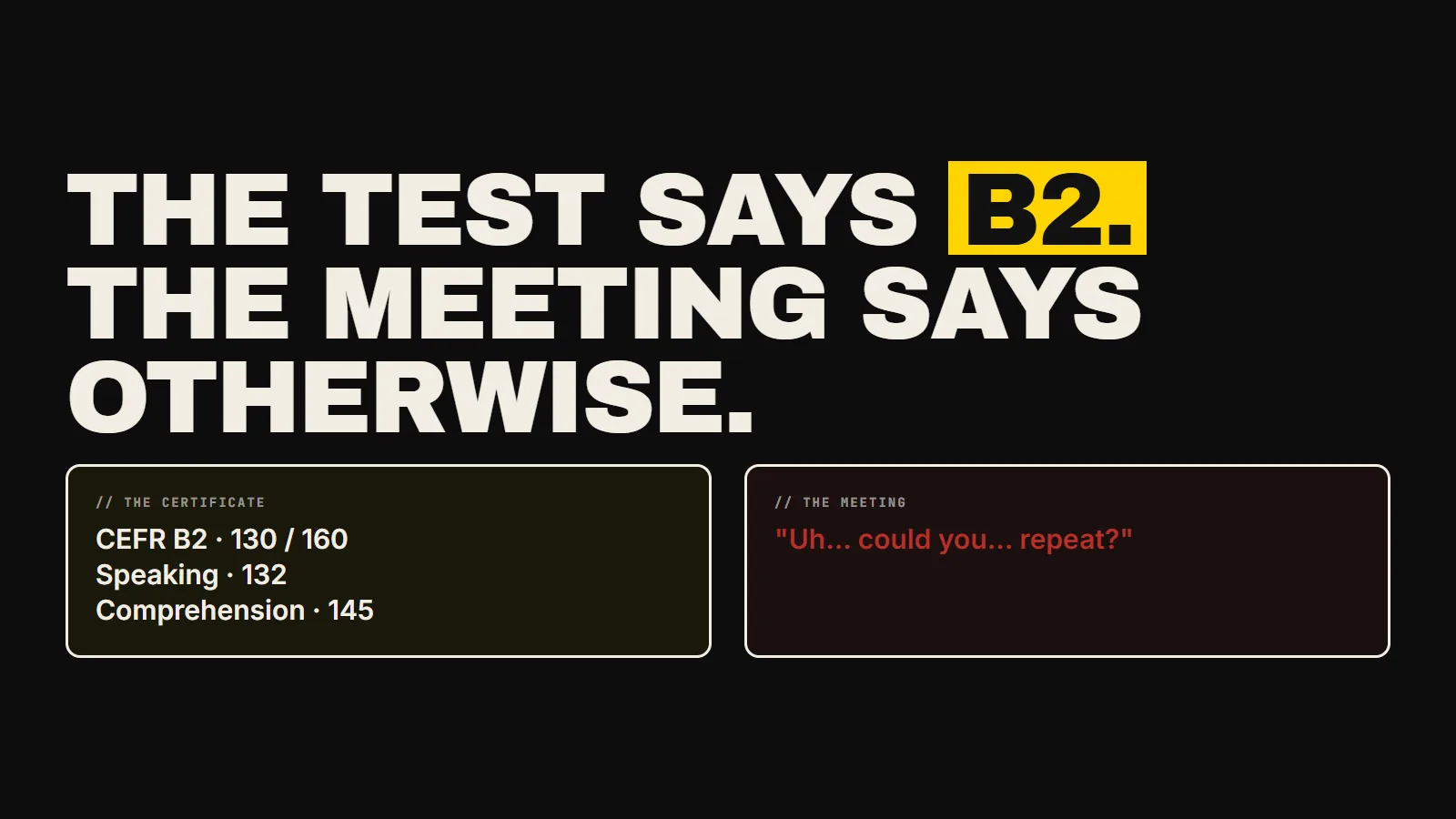
The Duolingo English Test (DET) score report shows up in your email. The number is solid. Your university accepts it. You tell people your English is good. Then a native speaker starts talking at normal speed, interrupts themselves, throws in a joke, and your brain does the thing where it translates word by word while the conversation moves on without you.
The test was not wrong about your English. It measured what it was designed to measure. The problem is that speaking in real life requires something different from what the DET tests — and most people learn this only after the uncomfortable experience.
TLDR
- The DET is an academic admission test, not a certificate of conversational ability. It measures language competence — vocabulary, grammar, reading, listening — with a limited speaking component.
- High DET score ≠ conversational fluency. The two are related but not the same skill.
- The gap is cognitive, not motivational. Formal test competence and real-time speaking fluency are processed differently by the brain.
- If your score is good but your speaking isn't: the fix is output practice, not more test prep.
What the Duolingo English Test Actually Measures
The DET assesses English language proficiency across four areas: reading, writing, listening, and speaking. It's accepted by thousands of universities worldwide as an alternative to IELTS and TOEFL, which is a legitimate use case for the test.
The speaking component of the DET involves reading sentences aloud, describing images, and a short spoken sample. These tasks measure pronunciation clarity and basic oral production. They do not measure your ability to respond in real time to an unpredictable interlocutor.
According to Duolingo's official documentation, the DET aligns with CEFR levels and is validated against academic language proficiency standards. For its stated purpose — university admissions screening — it works.
What it does not measure, by design: conversational fluency under social pressure, rapid processing of native speech, spontaneous topic shifts, register management, or the ability to hold your end of a conversation when the other person is talking fast, not waiting for you, and using idioms you might not know.
What the Test Doesn't (and Can't) Measure
The distinction that matters here is between linguistic competence and communicative competence.
Linguistic competence is knowledge of a language: vocabulary, grammar rules, pronunciation patterns. Tests measure this well. A well-designed test can give you an accurate picture of what you know.
Communicative competence is the ability to use that knowledge in real-time, under social pressure, with a real person who doesn't adjust their speech for your level. This is what speaking in real life requires. Tests have a much harder time measuring it, because real conversational pressure can only be approximated in controlled testing conditions.
There are specific skills that real conversation requires that the DET does not assess:
Real-time processing speed. A native speaker at normal conversational speed speaks approximately 150–180 words per minute. If you're still mentally translating from your native language, you fall behind the conversation in seconds.
Improvisation and repair. When you don't understand something in a real conversation, you need to ask for clarification, signal confusion, buy time, or guess and continue. The DET does not test this because it's not a live conversation.
Sociolinguistic range. Knowing when to be formal vs informal, how to soften a request, how to signal agreement or disagreement in culturally appropriate ways — this is deeply embedded in real speaking competence and essentially untestable in a standardized format.
Tolerance for ambiguity. In real conversations, you often don't understand everything and have to continue anyway. High-test-scorers sometimes freeze because they're used to the controlled conditions of a test, where every prompt has a right answer.
DET vs IELTS vs Real Conversation
| Criterion | DET | IELTS Speaking | Real Conversation |
|---|---|---|---|
| Format | Adaptive test, asynchronous | Live interview with an examiner | Unpredictable, live |
| Speaking component | Read aloud, describe, short sample | 3-part face-to-face interview, ~14 min | No time limit, any topic |
| Measures linguistic competence | Yes | Yes | Yes |
| Measures conversational fluency | Partially | Better than DET | Fully |
| Tests improvisation/repair | No | Partially | Yes |
| Accepted by universities | 5,000+ institutions | Very widely accepted | N/A |
| Replication of real-world speaking | Low | Moderate | N/A — this is the real thing |
Neither the DET nor IELTS is a bad test. They're the right tool for their purpose: academic admission screening. The gap appears when learners treat a test score as a proxy for conversational readiness.
The "High Score, Can't Speak" Paradox
This experience is common enough that applied linguists have a name for the phenomenon: the competence-performance gap. Your competence (what you know about English) is measured by the test. Your performance (what you can do with English in real conditions) is what happens in the video call.
Why do they diverge? Several reasons converge:
Preparation for a specific task. DET prep involves practicing the DET format: read-aloud tasks, image descriptions, vocabulary exercises. This improves DET performance. It does not transfer automatically to spontaneous conversation.
Test conditions remove social pressure. The DET is taken alone, asynchronously. There's no person waiting for your response, no eye contact, no social consequence for a pause. Real speaking involves all of these things, which activate different cognitive and emotional responses.
High accuracy orientation. People who study for tests develop an accuracy-first orientation — they check their answer before committing. In conversation, this shows up as pausing to translate, editing in your head before speaking, or going silent when uncertain. Conversational fluency requires a different orientation: communicate, even imperfectly.
The CEFR correlation data between DET and IELTS speaking shows generally aligned scores, but IELTS speaking tests live conversational ability more directly. A DET score of 120–130 (roughly B2) does not guarantee a strong IELTS Speaking score of 7.0, because the tasks are different in kind, not just degree.
What to Do If Your Score Is Good But Your Speaking Isn't
The good news: linguistic competence (which you have, if your DET score is solid) is the foundation. You're not starting from zero. The gap is in the output — the actual speaking — not in the underlying knowledge.
What helps, in order of effectiveness:
1. Speaking output practice, a lot of it. The only way to build conversational fluency is to have conversations. AI speaking tools (Satur, Speak, Talkpal), conversation exchange partners (Tandem, HelloTalk), or tutors on italki. The goal is accumulated hours of speaking, not more study.
2. Listening to native speech at normal speed. Not with subtitles as a crutch. Movies, podcasts, YouTube at 1.0× speed. Train your ear to track normal-speed English.
3. Working on fluency specifically, not accuracy. Practice speaking without stopping to correct yourself. Say things imperfectly. Keep going. Accuracy improves after fluency is established, not before.
4. Simulating real-conversation pressure. Timed responses, unexpected topics, conversations you can't prepare for in advance. This is what makes AI scenario tools useful — the situation is unpredictable within a controlled frame.
Getting comfortable in actual conversations takes months of output practice, not test prep. But the linguistic foundation from your DET preparation is real and useful — it just needs a different kind of exercise.
The Specific Transition: From Test Performance to Real Speaking
There's a cognitive shift required when moving from test-preparation mode to conversational mode. Understanding what it is makes the transition faster.
Test mode: check before you commit. Evaluate your answer. Prioritise accuracy. Avoid errors. The scoring system rewards correct answers.
Conversation mode: communicate first. Accept imperfection. Prioritise speed and clarity over accuracy. The "scoring system" is whether you got your point across.
These are not just different strategies — they're different cognitive orientations. Test mode is careful and deliberate. Conversation mode is automatic and approximate. Switching from one to the other takes practice specifically in the second mode.
This is why DET preparation, even excellent preparation, doesn't automatically produce conversational fluency. The skills overlap but the orientation doesn't. A test-prepared learner with a score of 130 still needs to log hours in conversation mode — where the acceptable error rate is much higher, the pacing is determined by someone else, and "good enough" is the operational standard.
The research on skill transfer in second language acquisition (DeKeyser, 2007) supports this: skills developed under one set of conditions do not automatically transfer to significantly different conditions. Conversational fluency is a skill learned through conversational practice, not through adjacent skills developed under test conditions.
For most learners who've done significant DET prep, this means: stop studying, start talking. The knowledge is there. It needs a different kind of exercise to become usable in conversation.
FAQ
Do universities accept the Duolingo English Test?
Yes. As of 2026, over 5,000 universities and institutions accept the DET, including many in the US, UK, Canada, and Australia. Acceptance policies vary by program. Check directly with your target institution.
Is the DET or IELTS easier?
The DET is generally considered more accessible for several reasons: it's taken at home, costs significantly less (~$65 vs $200+ for IELTS), results come within 48 hours, and the adaptive format means it adjusts to your level. For conversational speaking ability specifically, IELTS's live interview tests it more directly. Neither is "easier" in an absolute sense — they test the same general competence through different formats.
Does DET preparation help with real speaking?
Partially. DET preparation builds vocabulary and grammar knowledge, which underlies all English ability. The speaking-specific exercises (read-aloud, sample responses) build some confidence with oral production. But DET prep does not replicate the conditions of real conversation. If conversational fluency is your goal, you need output practice beyond test preparation.
How do I improve my speaking if my DET score is already high?
Increase your volume of actual speaking. This means conversations, not more test exercises. Options: AI conversation partners (Satur, Speak, Talkpal) for daily practice, language exchange apps for human interaction, or tutors for structured feedback. Target at least 20–30 minutes of actual speaking output per day.
Is there a test that actually measures real speaking ability?
The closest standardised options are IELTS Speaking (live face-to-face interview with an examiner, about 14 minutes) and OPI/OPIC (Oral Proficiency Interview, used by government and military language programs). Both involve live, unscripted interaction, which approximates real conversation better than asynchronous tests. Neither is perfect, but they measure communicative competence more directly than the DET.
If Your Score Is Good but Speaking Feels Stuck
Satur is built for exactly this situation: people who already know English but can't get it out in real conversations. Daily scenarios — situations where you have to speak to get somewhere, not answer a multiple-choice question. No credit card required to try it.
Internal Links
- Why You Can't Speak English After Years of Duolingo
- The Intermediate Plateau in English: Why You're Stuck at B1/B2
- English Job Interview Prep for Non-Native Speakers
External Links
- Duolingo English Test — Official Site — what the DET measures
- CEFR Framework — Council of Europe — CEFR level correlations