How to Prepare for a Job Interview in English When You're Not a Native Speaker
You have the skills. But when the interview switches to English, your brain freezes. Here's how to prepare — with 30 phrases that sound like a professional, not a textbook.
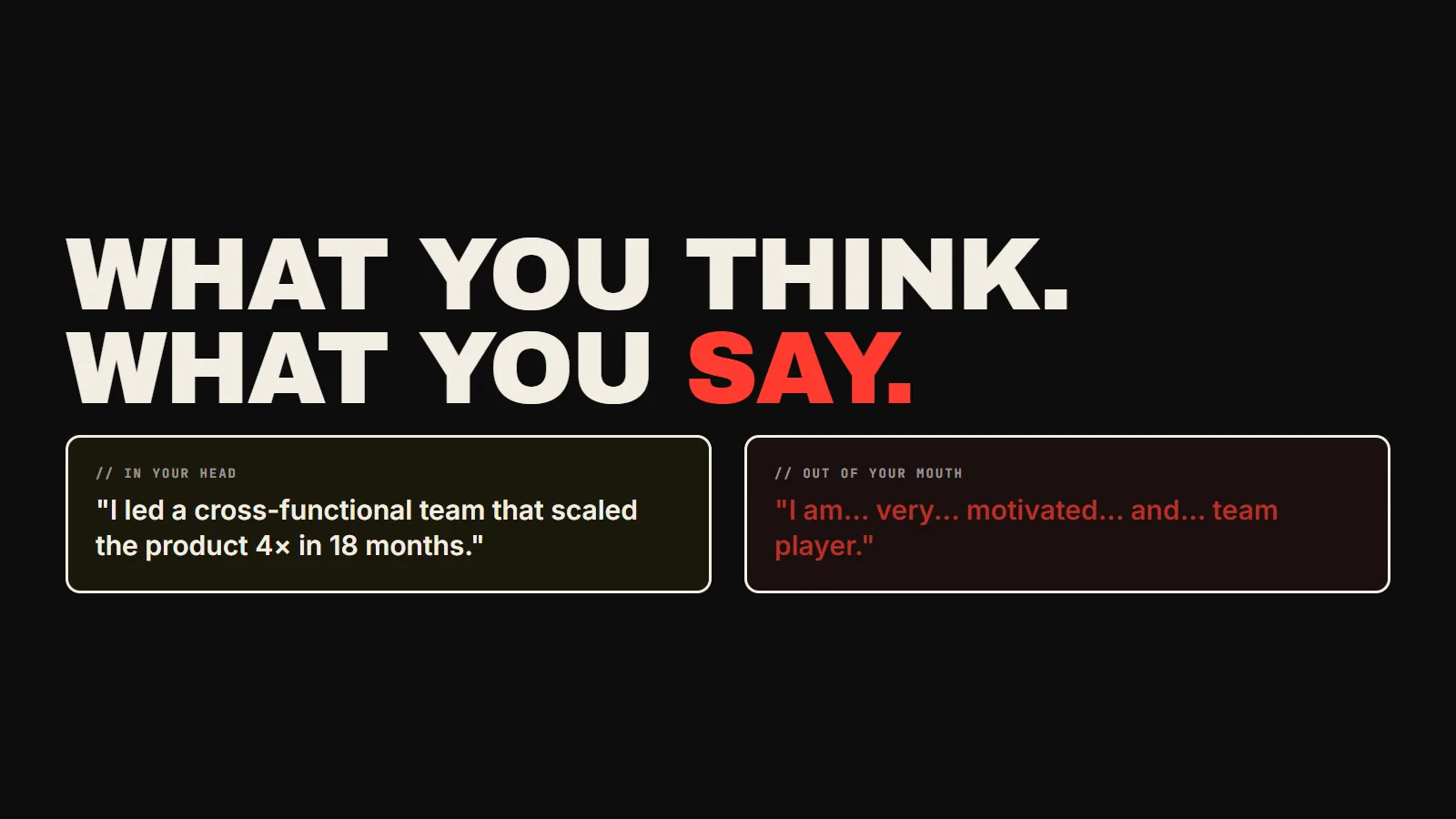
The skills are not the problem. You have the experience, the qualifications, the track record. The problem is that when the interviewer switches to English and asks «Tell me about yourself», your brain does what brains do under linguistic pressure: it empties. You know what you want to say. The words don't come. You default to «I am very motivated person who like to work in team.»
The interviewer hears this and, fairly or not, adjusts their assessment of your professional competence. This is the gap between what you know and what you can perform under pressure.
The good news: this gap is specific and trainable. You don't need fluent English. You need the specific phrases, structures, and reflex for 5 types of questions that appear in virtually every professional interview. Here they are.
TLDR:
- Non-native speakers fail English interviews not because of language knowledge but because of insufficient practice under real-time pressure.
- There are 5 types of interview questions, and they follow predictable structures.
- 30 professional phrases cover the critical moments in most interviews.
- A 2-week practice plan that actually works — with daily time under 20 minutes.
Why Most Non-Native Speakers Fail English Interviews
It's not vocabulary. Most professional non-native speakers at B2 level have the vocabulary. It's not grammar — interviewers at multinational companies have heard every grammatical variation. The problem is response latency.
In your native language, you can construct a professional answer in milliseconds. In English, you're simultaneously translating, organising, grammar-checking, and speaking. The cognitive load is enormous. Under stress, processing time doubles. A 2-second pause in your native language sounds thoughtful. In a foreign language, it looks like you don't know the answer.
Practice doesn't eliminate this gap — but it reduces it. When you've said «The reason I'm applying for this role is...» 50 times, it no longer requires construction. It fires as a reflex. Your brain can focus on content, not mechanics.
According to CEFR B2 descriptors (Council of Europe), a B2 speaker «can interact with a degree of fluency and spontaneity that makes regular interaction with native speakers quite possible without strain for either party.» The word is spontaneity. Not perfection. Spontaneity. That's what interview practice builds.
The 5 Types of Interview Questions (and How to Handle Each)
1. Tell Me About Yourself
This is not a casual opener. It's a structured professional summary request. The question sounds open-ended but has an expected format: relevant background, current position, why you're here.
Structure: Past → Present → Why this role.
Phrases that work:
- «I've spent the past [X] years working in [field], focused mainly on [area].»
- «Most recently I was [title/company], where I [key achievement].»
- «I'm now looking for [what], which is what drew me to this opportunity.»
What to avoid: Starting with «I was born in...» or listing your CV chronologically. The interviewer has your CV. They want to know how you frame your career.
Practice: Write a 90-second version. Record yourself. Time it. Do this 10 times until it flows without hesitation.
2. Why This Company?
This question tests whether you've done research or are spray-applying. The answer should be specific to the company, not generic («I've always admired your work»).
Structure: Specific observation → connection to your skills → what you'd contribute.
Phrases that work:
- «I've been following [company] for a while, specifically your work on [specific initiative/product/approach].»
- «What stood out to me was [specific thing] — and that aligns with how I think about [your area].»
- «I think the combination of [company strength] and my background in [your background] could be a strong fit.»
What to avoid: «Because you're a great company with good opportunities.» Every company is hearing this. It signals you did no research.
3. Describe a Challenge You Overcame
This is a behavioural question. The expected format is STAR: Situation, Task, Action, Result. Interviewers trained in structured interviewing score your answer against this framework explicitly — whether you know it or not.
STAR structure:
- Situation: «We were facing a situation where [brief context].»
- Task: «My responsibility was to [what you needed to do].»
- Action: «I [specific steps you took] — I chose this approach because [brief rationale].»
- Result: «As a result, [specific measurable outcome].»
Phrases that work:
- «This was a situation where the usual approach wasn't working.»
- «I decided to [action] — which was unusual, but the reasoning was [reason].»
- «The outcome was [result] — and that's something I reference when [similar situations].»
The trap for non-native speakers: Telling the story without getting to the result. Time pressure plus linguistic load makes you run long on Situation and short on Result. Practice cutting Situation down and expanding Result.
4. What Are Your Weaknesses?
The question interviewers ask because they want to see self-awareness, not because they believe you'll tell the truth about your worst flaw. The right answer: a real weakness you've actively worked on, with evidence of progress.
What to avoid: «I work too hard» / «I'm a perfectionist» — these are non-answers and experienced interviewers treat them as red flags for self-awareness.
What works: A real area for improvement, briefly explained, with a specific thing you've done about it.
Phrases:
- «One area I've actively worked on is [specific skill/area].»
- «A year ago, I [honest description of the gap]. I've since [specific action taken] — and I can see the difference in [evidence].»
- «I wouldn't call it resolved, but it's no longer something I avoid — I approach it [how].»
5. Do You Have Questions?
«No, I think you've covered everything» is a missed opportunity. It signals low engagement. Have at least 2 prepared questions.
Questions that work:
- «What does success look like in this role in the first 6 months?»
- «What are the biggest challenges the team is facing right now?»
- «How would you describe the decision-making culture here?»
Questions to avoid: Anything easily findable on the company website, salary questions in a first interview (unless they bring it up), vague questions like «What's the culture like?»
30 Professional Phrases for English Interviews
These are not vocabulary lists. They're production units — phrases your brain should retrieve as blocks, not construct word by word.
Opening and introduction:
- «I've spent the past [X] years working in [field]...»
- «Most recently I was [role] at [company], where I...»
- «What drew me to this opportunity is...»
- «I'm looking for [specific type of next role] because...»
- «Happy to elaborate on any of that if helpful.»
Explaining your experience:
- «In that role, my main responsibility was to...»
- «The challenge we were facing was...»
- «I decided to approach it by...»
- «The outcome was [result] — specifically [measurable outcome].»
- «That experience taught me [learning].»
Asking for clarification (without sounding lost):
- «Could you tell me a bit more about what you're looking for there?»
- «When you say [term], do you mean [your interpretation]?»
- «I want to make sure I'm addressing what you're asking — is the question more about [X] or [Y]?»
Buying time without going silent:
- «That's a good question — let me think about that for a second.»
- «I want to give you a specific example, so...»
- «Off the top of my head — and I can give you more detail after — [answer].»
Strengths and expertise:
- «The area I'm most confident in is...»
- «Where I've consistently delivered value is...»
- «The feedback I get most often from colleagues is...»
Weakness / development:
- «One area I've actively worked on is...»
- «A year ago I would have said [weakness]. I've since [specific action].»
- «I don't consider it fully resolved, but [progress].»
Interest in the company:
- «I've been following [company] specifically because of [specific thing].»
- «What stood out to me in your recent [report/product/initiative] was...»
- «I think the combination of [company strength] and my background could [benefit].»
Closing and questions:
- «What does success look like in this role in the first six months?»
- «What are the biggest challenges the team is dealing with right now?»
- «How would you describe the decision-making culture?»
- «Is there anything you've heard today that gives you pause about my fit for this role?»
- «What are the next steps in the process?»
A 2-Week Practice Plan
This is not a commitment to 2 hours per day. It's 15–20 minutes a day for 14 days.
Days 1–3: Write your Tell Me About Yourself answer. Record yourself. Time it: target 90 seconds. Listen back. Rewrite. Repeat daily until you stop hesitating on the transitions.
Days 4–6: Prepare one STAR story per day — a different professional challenge each day. Out loud, not written. Time yourself on Result — it should take at least 20% of the story.
Days 7–9: Practice the weakness question. Record 3 different versions. Listen for phrases that sound rehearsed but hollow vs phrases that sound genuine. Keep the genuine one.
Days 10–12: Practice with a conversation partner, tutor, or AI tool. Do a 15-minute mock interview — full format, not individual questions. Note where your speed drops and your hedging increases.
Days 13–14: Practice the questions you'll ask. Say them out loud. Know them well enough to choose in the moment, not script them in order.
For conversational pressure practice, Satur has a Job Interview scenario built specifically for this — a character who plays the interviewer without patience for long pauses. It's not gentle. That's the point.
See also: Real-Life English Conversations You Actually Need to Practise — for the broader context of professional English under pressure.
For managing speaking anxiety: Speaking Anxiety in English: Why It Happens and How to Practise Without Freezing Up.
Common Mistakes Non-Native Speakers Make in English Interviews
- Translating from your native language word by word. Produces grammatically odd English that sounds unconfident. Better: learn the phrases as chunks, not words.
- Using filler sounds from your native language («eem», «euuh») instead of English fillers («well», «right», «so»). It's a subtle signal but real.
- Over-apologising for your English. «My English is not very good but...» undermines you before you've said anything substantive. Don't do this.
- Answering too quickly to avoid pausing. A 1-second pause with «let me think about that» sounds more professional than an immediate but incomplete answer.
- Going too long on Situation in STAR answers. Context is setup. The interviewer wants to hear what you did and what happened. 20% Situation, 40% Action, 40% Result is the right ratio.
FAQ
What level of English do I need for a job in an international company?
Most international companies expect B2 (CEFR) as a working minimum — the level at which you can sustain professional conversations without strain. Some roles require C1 (near-native fluency). Very few roles in non-English-speaking countries require native-level English. Check the job description: if it says «business English», B2 is sufficient; if it says «native speaker», it usually means C2 or actual native.
How do I answer behavioural questions in English?
Use the STAR method: Situation → Task → Action → Result. Structure your story before you speak — «let me give you a specific example» buys you two seconds. Keep Situation brief. Expand Action and Result. End with a clear number or outcome.
Should I tell the interviewer I'm not a native speaker?
Usually not explicitly — they can tell, and stating it doesn't help. If your accent or fluency becomes an issue, a better approach is: «I want to make sure I explained that clearly — would it help if I gave you a specific example?» This demonstrates awareness without apologising.
Can I ask the interviewer to repeat a question?
Yes. This is completely standard in native-speaker interviews too. «Could you rephrase that? I want to make sure I'm addressing the right thing» is professional. Answering a question you misunderstood is worse than asking for a repeat.
Links
External:
- Council of Europe: CEFR Level Descriptors — coe.int
- Harvard Business Review: Structured Behavioral Interviews and STAR Method
- STAR Method: widely attributed to development assessment literature; commonly used in Amazon, Google, McKinsey hiring processes