Real-Life English Conversations You Actually Need to Practise (Not Airport Dialogues)
Not
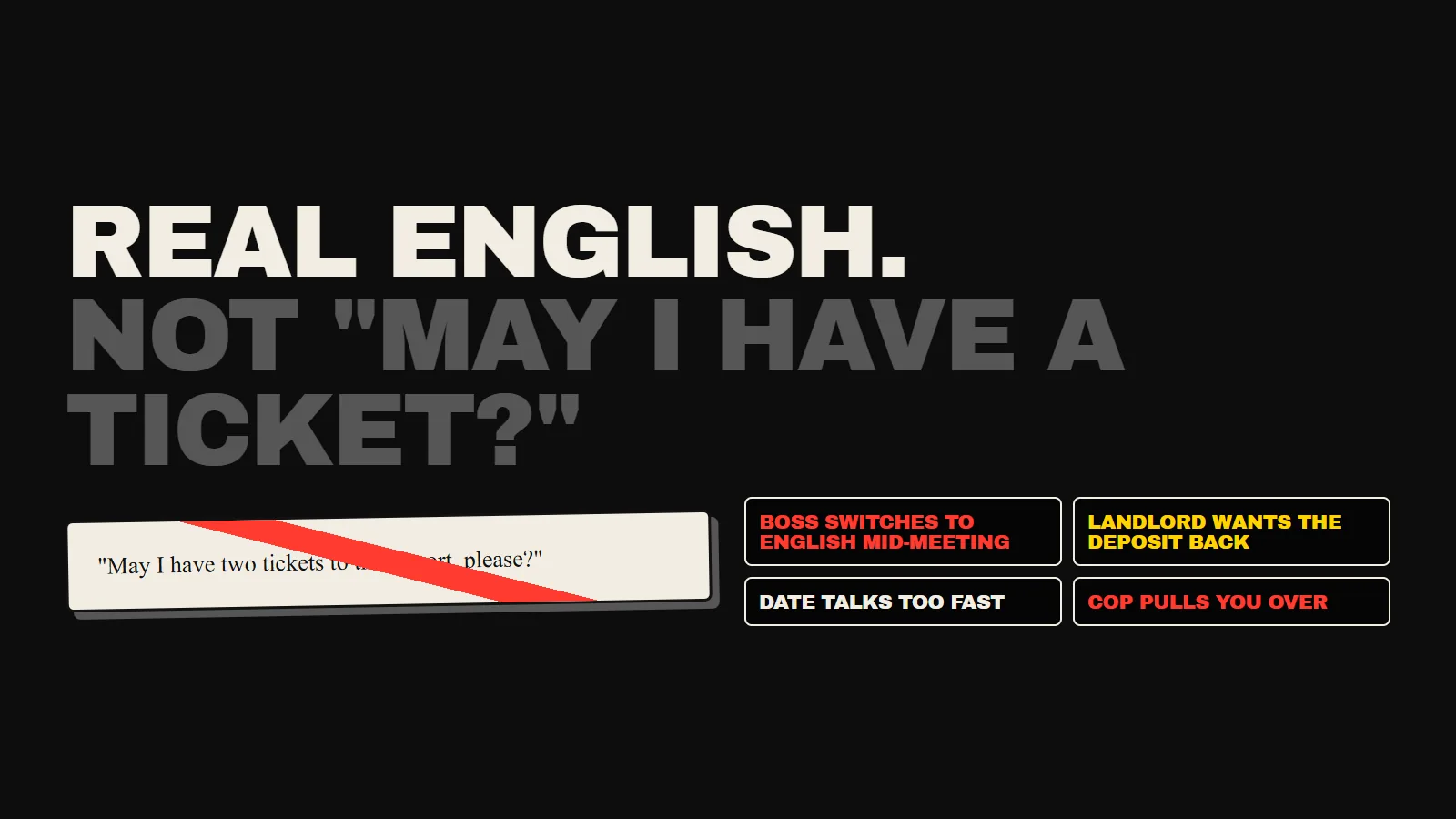
Language textbooks have been teaching the same airport dialogue for 40 years. «Two tickets to London, please.» «Certainly. Smoking or non-smoking?» Nobody has asked about smoking on a plane since 1998. Nobody was ever going to freeze up asking for a train ticket. The conversations that actually matter — the ones where your hands go cold and your brain empties — are never in the textbooks.
Here are 10 of them, why they're hard, and how to get ready for them.
TLDR:
- Real conversations happen under pressure, time constraints, and social stakes. Textbook English doesn't prepare you for any of this.
- The hardest English situations: professional conflict, social negotiation, unexpected questions from authority, rapid-fire informal talk.
- Practising specific scenarios beats generic "conversation practice" — your brain needs the pattern, not just the vocabulary.
Why "Airport English" Is a Lie
The textbook airport scenario is designed to be learnable — not realistic. It follows a script: greet, state your need, receive confirmation, thank and leave. Both parties know their role. There's no improvisation, no pressure, no social stakes.
Real conversations don't work like this. Real conversations involve interruption, ambiguity, subtext, and unexpected turns. Your boss switches to English mid-meeting without warning. Your landlord emails a claim about the deposit and wants a response now. A cop asks what you were doing and you have 10 seconds.
According to research by the British Council on communicative language teaching, learners who practise in context-rich, unpredictable situations develop conversational resilience — the ability to manage when things don't go to plan. Scripted dialogue practice doesn't build this resilience. Scenario-based practice does.
The 10 situations below are not hypothetical. They are the specific conversations that non-native English speakers consistently identify as the moments their English fails them — not vocabulary, not grammar, but the reflex to produce coherent language under pressure.
10 Conversations You'll Actually Have in English
1. Your Boss Switches to English Mid-Meeting
The meeting is in your language. Then your boss says, in English: «Actually, could you explain that again? Our colleagues from London are on the call.»
Why it's hard: No preparation. No script. You have to explain something technical, professionally, in real time, to people who are judging your competence. Silence is the worst answer.
What you need: Bridging phrases. «So to summarise what I was just saying...» «Let me translate the key point...» «In short — the issue is X, and the solution we proposed is Y.»
What to practise: Summarising your work in 60 seconds in English, without notes, several times per week.
2. The Landlord Wants the Deposit Back and You Disagree
You moved out. The landlord says you owe for repairs. You disagree. The amount is significant. This conversation has financial stakes and no neutral party.
Why it's hard: Negotiation in English requires you to be firm without being rude, specific without being aggressive. Anger makes your English collapse first. You default to your native language patterns, which may translate badly.
What you need: Dispute phrases. «I don't agree with that assessment.» «Could you send that in writing?» «I'd like to review the original inventory.» «I'm happy to discuss this, but I need documentation first.»
What to practise: Role-playing a disagreement where the other side is wrong and won't immediately concede.
3. A Date Who Speaks Too Fast
You matched. You agreed to meet. They're a native speaker or very fluent. They're talking at normal speed — which is about 40% faster than you're ready for. You're nodding. You don't understand half of what they said.
Why it's hard: Social pressure to not ask "what?" for the fifth time. You want to appear fluent. You're also simultaneously trying to be interesting and charming in a language that isn't yours.
What you need: Natural stall phrases that don't sound like «I didn't understand you.» «Ha, say that again — I want to make sure I'm tracking.» «Actually — back up. What did you mean by that?»
What to practise: Conversational English at native speed. Not textbook speed. Podcasts, conversations, anything where people talk fast and informally.
4. A Cop Pulls You Over
Routine traffic stop. Or not routine — a border crossing, an airport security question, a street check. You're nervous. The other person has authority. You need to be clear, cooperative, and not accidentally say something that sounds suspicious.
Why it's hard: Stress collapses vocabulary. Legal register is unfamiliar. The social stakes are high and the acceptable response window is narrow.
What you need: De-escalation phrases. «Yes, officer.» «I was — [specific action], not [what they might think].» «Do I need a lawyer?» «I don't understand what you're asking — could you rephrase?»
What to practise: Satur has a scenario for exactly this — DUI Stop. It simulates authority pressure and requires you to explain yourself under time pressure.
5. You're Late to a Meeting and Need to Explain
Not just «sorry I'm late.» The meeting started without you, important things happened, and now you need to explain yourself to your manager in English, buy back trust, and re-enter the conversation smoothly.
Why it's hard: Apology in English has a specific register — «I apologise» sounds formal; «I'm sorry» sounds enough only in certain contexts; «I was held up» is the correct informal phrase. Getting it wrong reads as insincere or evasive.
What you need: Professional recovery phrases. «I apologise — I was held up in [X]. What did I miss?» «I'm catching up now — could someone give me the thirty-second version?»
What to practise: Explaining lateness and errors professionally. The STAR method helps for more serious explanations.
6. The Doctor Asks Questions You Don't Know the Medical Terms For
You're sick. The doctor asks what hurts, for how long, what the symptoms are. You know your body. You don't know the English terms for the symptom that's been bothering you for a week.
Why it's hard: Medical vocabulary is rarely taught. The stakes are high — misunderstanding can mean wrong treatment. Anxiety raises the cognitive load further.
What you need: Description workarounds. «It's like a dull pressure — not sharp, just heavy.» «It started here and moved to here.» «It gets worse when I [do this] and better when I [rest].»
What to practise: Describing physical sensations without medical jargon. Your brain can work around unknown words if you practise the skill of paraphrase.
7. Your Airbnb Host Is Complaining
You checked in. Something happened — noise complaint, checkout time dispute, something missing. The host is unhappy. The conversation happens in English because that's the common language.
Why it's hard: Hospitality conflict has a specific social register. You want to protect your deposit, appear reasonable, and avoid escalation — all simultaneously.
What you need: Conflict de-escalation phrases. «I understand there's been a misunderstanding.» «What would resolve this for you?» «I'm happy to discuss this but I'd like to check the listing first.»
What to practise: Keeping composure in disagreements. The instinct to either over-apologise or get defensive is strong — both are wrong here.
8. You're the Only Non-Native in the Room
A social gathering. Everyone else is fluent. The conversation moves fast, references you don't get, jokes with timing that needs instant comprehension. You smile and nod. You're not following.
Why it's hard: Admitting you didn't follow is socially vulnerable. Following up on every missed reference slows the conversation. Silence looks like disengagement.
What you need: Participation phrases that don't require full comprehension. «Ha, what was that?» «Wait — I missed the first part, back up.» «I'm with you up to X — then you lost me.» Laughing when others laugh is fine until it's not — learn when to confirm.
What to practise: Conversations at native speed with multiple people talking. Not one-on-one slow English. The chaos is the point.
9. Someone Asks Your Opinion on a Political Topic
At a party, a work event, or online. Someone asks what you think about [political situation]. It's their country, your non-native status, and you have an opinion but you're not sure of the register.
Why it's hard: Political English has pitfalls — words that mean one thing in your culture and something loaded in English. Hedging too much looks dishonest. Being too direct might offend.
What you need: Opinion framing. «I'm probably not the right person to comment on the internal politics, but from the outside it looks like...» «I don't know enough to have a strong view, but...»
What to practise: Giving opinions on mildly controversial topics. Not to be provocative — to build the reflex of expressing a nuanced view clearly.
10. Drunk Conversation at a Party
Informal. Fast. People are louder. Slang is thick. Background noise. You've had one or two. Your English, which was okay at the start of the evening, is now running on less RAM.
Why it's hard: Informal rapid-fire English is the hardest register. Comprehension drops. Production slows. And the social pressure to keep up with the conversation is highest here.
What you need: The reflex. Not vocabulary lists — reflexes. The ability to say something natural without thinking. «Yeah exactly.» «Wait, seriously?» «No way.» «Tell me more.»
What to practise: Fast, informal English. Native podcasts, bar conversation simulations, scenarios with informal register.
How to Actually Practise These
There are three ways, in ascending order of effectiveness:
Shadow and repeat. Take real conversations from YouTube, podcasts, or TV. Shadow — speak along with the audio, matching speed and intonation. This builds your informal reflex without requiring a partner.
Conversation exchange. Find a language partner (through Tandem, HelloTalk, or similar). Ask them to put you in uncomfortable scenarios. Ask them to speak at full speed. This requires coordination but is free.
AI scenario practice. Tools like Satur are built around specific scenarios — not generic chat. DUI Stop, Work Conflict, Tinder Ghost, Bar Fight Mediator. You're thrown into a situation with a character who won't slow down and won't let you off easy. No preparation, no script.
For English job interview preparation specifically, see: How to Prepare for a Job Interview in English When You're Not a Native Speaker.
For building the daily speaking habit: How to Practise English Conversation When You Have No One to Talk To.
FAQ
Where can I find real English conversation practice?
Language exchange apps (Tandem, HelloTalk), conversation clubs, online tutors (italki for informal sessions), and AI speaking tools. The key requirement is that the other person doesn't slow down or simplify for you. Comfortable practice doesn't build real-world resilience.
What English level do I need for real-life conversations?
CEFR B1 is the threshold where you can manage most daily situations, according to the Council of Europe descriptors. B2 means you can handle professional and social situations with native speakers without strain. But you don't wait until you reach a level — you practise the conversations that are slightly above your current comfort zone and you improve by doing them, not by preparing.
How do I practise English for work?
Find the specific work situations you're likely to face: presenting, disagreeing in a meeting, explaining a delay, giving feedback. Practise those scenarios. Generic «professional English» courses spend too much time on vocabulary you won't use. See: Real-Life Conversations for Business English.
Links
External:
- British Council: Communicative Language Teaching — research on context-rich conversation practice
- Council of Europe: CEFR B1/B2 Descriptors for Communicative Competence