Why Confident English Speakers Aren't Better at Grammar (They're Just Less Afraid)
The most confident English speakers aren't the ones with perfect grammar. They're the ones who stopped caring about making mistakes. Here's what confidence actually is — and how to build it.
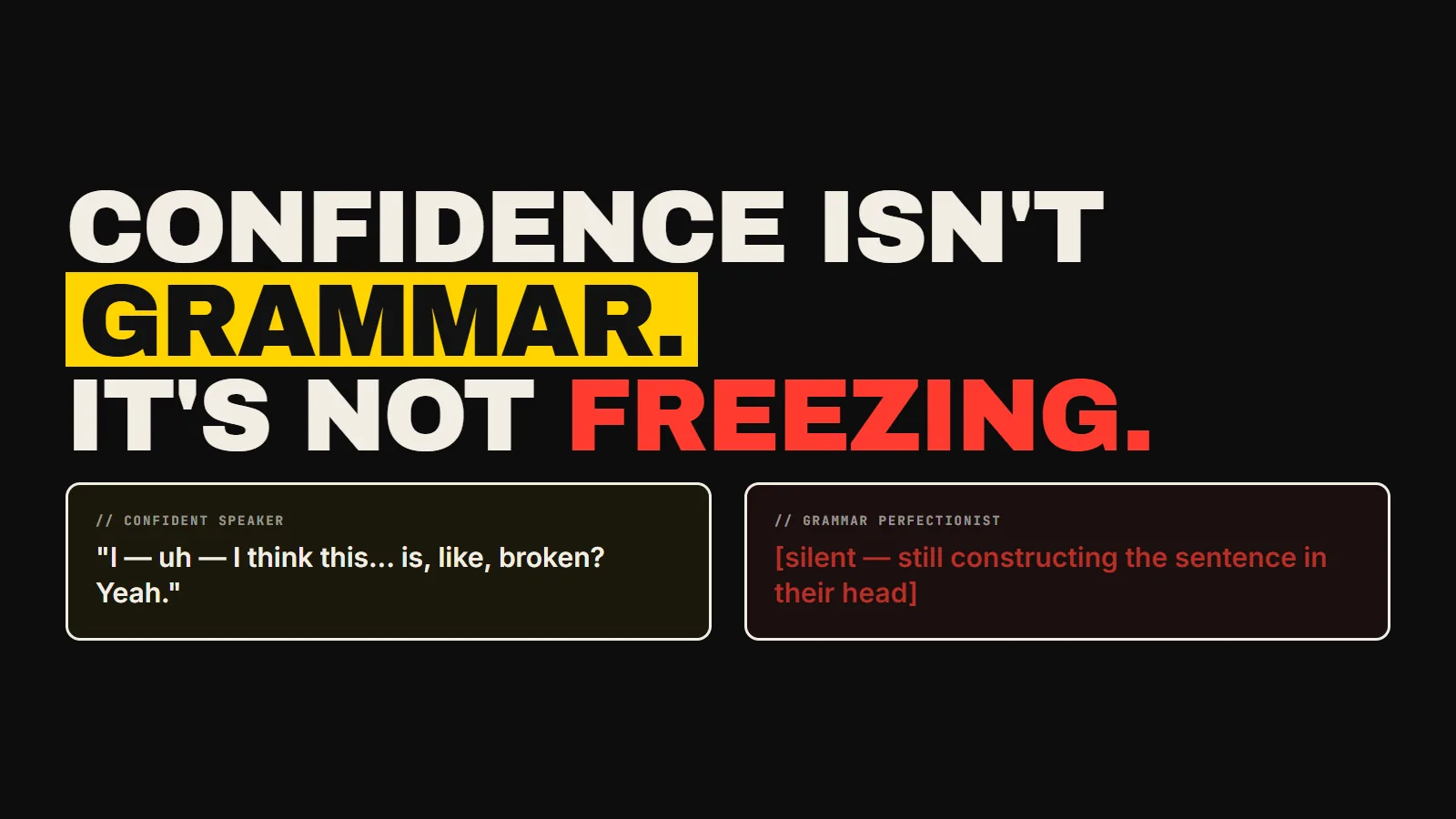
There's a learner in every language class who speaks fluently despite making grammar mistakes the textbook corrects. And there's another who can write perfect sentences but falls silent when someone speaks to them. The difference between them isn't knowledge. It's willingness to be wrong in real time.
Confidence in English speaking is a behaviour, not a level. It's not correlated with grammar accuracy the way most learners assume. Some of the most confident English speakers — in terms of social effectiveness and communication outcomes — make regular grammatical errors. Some of the most grammatically precise learners communicate almost nothing because they won't speak until they're sure.
This is worth understanding precisely because the standard advice — study more, improve your vocabulary, get your grammar right — is aimed at the wrong target.
TLDR
- Confidence is not correlated with grammar accuracy. Research consistently shows that perceived confidence and communicative effectiveness are more related to tolerance for imperfection than to linguistic accuracy.
- The mechanism is Krashen's Affective Filter: high anxiety blocks language output regardless of language knowledge.
- Confident speakers share five behaviours — none of them are about grammar.
- Building confidence requires practice under pressure, not more study. Exposure to error in low-stakes environments reduces the anxiety response over time.
The Grammar Trap — Why You Think You're Not Ready
The trap works like this: you know your grammar isn't perfect. So you decide to speak after you've improved your grammar. This is a logical sequence that doesn't work.
Grammar improves through feedback on output, not through pre-emptive avoidance of output. You don't get feedback on language you never produce. Waiting to speak until you're grammatically ready is waiting for something that only happens by speaking.
This is different from saying grammar doesn't matter. Grammar matters for precision, for professional contexts, for avoiding misunderstanding. But grammar doesn't gate speaking confidence — speaking confidence gates speaking, and speaking is what improves grammar.
Carol Dweck's growth mindset research (2006) is directly relevant here. In language learning applications, a fixed mindset about language ability ("I'm not good at languages") predicts avoidance of production. A growth mindset ("errors are feedback, not failure") predicts engagement and improvement. The difference in outcomes between these two orientations is significant.
What Confident Speakers Actually Do Differently
Watch someone who communicates confidently in English — especially someone who isn't a native speaker — and you'll see a specific pattern of behaviours. None of them are about grammar.
They accept the pause. When a confident speaker doesn't immediately know the word, they pause. They don't apologise for the pause. They don't abandon the sentence. They wait, find the word or an approximation, and continue. The pause is normal. The panic response to the pause — over-apologising, abandoning the sentence mid-way, switching to native language — is what signals anxiety, not incompetence.
They approximate. If the exact word isn't available, they describe it. "The thing you use to — it's like a lever but smaller" is functional communication. It keeps the conversation moving. Learners waiting for exact vocabulary usually stay silent. Confident speakers use what they have.
They treat errors as information. When a confident speaker is corrected, they incorporate the correction and continue. They don't replay the error mentally for the next five minutes. Error is not shame — it's data. This is the behavioural manifestation of Dweck's growth mindset in real-time conversation.
They match energy, not precision. In casual conversation, confidence reads through tone, body language, pace, and engagement. A speaker who is energetically present and makes some grammatical errors often reads as more confident than a speaker who produces technically correct sentences with high anxiety visible in their delivery.
They start sentences without knowing how they'll end. This is the most specific and learnable behaviour. Native speakers do this constantly — they begin a sentence with a direction and construct it in real time. Non-native speakers who've been trained in written production often try to pre-formulate the entire sentence before speaking. This creates exactly the freeze response that reads as low confidence.
The Science Behind Speaking Confidence
Stephen Krashen's Affective Filter Hypothesis (1982) describes the mechanism directly. The affective filter is a mental block — influenced by anxiety, low motivation, or low self-confidence — that prevents language input from reaching the language acquisition device. When the filter is high, language available in your knowledge base is not available for production.
This explains why a person who demonstrates solid grammar in writing can freeze in conversation. The knowledge is there. The anxiety raises the filter, blocking access to the knowledge.
Empirical research by MacIntyre & Gardner (1994) confirmed the language anxiety construct — they found it to be distinct from general anxiety, specifically triggered by second-language production tasks, and consistently negatively correlated with speaking performance and speaking frequency. Lower anxiety predicts more speaking. More speaking predicts higher fluency. The chain runs from anxiety to fluency, not from grammar to confidence.
The practical implication: interventions that reduce speaking anxiety are more effective at building confident speaking than interventions that improve grammar accuracy. This doesn't mean grammar instruction is useless — it means it's not the lever for speaking confidence specifically.
5 Ways to Build Speaking Confidence
1. Practise errors deliberately Produce English in a low-stakes environment where the goal is to speak, not to be correct. AI conversation apps, language exchange partners, speaking clubs. The environment matters: you need somewhere the errors don't matter. Over many repetitions, the anxiety response to being wrong in English decreases.
2. Use partial success as full success If you communicate what you intended — even imperfectly — that's a success. Reframing this is not positive thinking; it's accurate assessment. Partial grammar error + full communicative success = successful communication. Treating it as failure because of the grammar error is a cognitive distortion that increases the filter.
3. Practise sentence beginnings without knowing the ending Start sentences on purpose without having formulated the end. This builds the in-real-time construction habit. It feels uncomfortable. Do it anyway, in low-stakes environments first (self-recording, AI conversation).
4. Seek high-pressure, low-consequence practice The specific kind of environment that builds confidence is one with real pressure (something at stake in the scenario) and low actual consequence (no real relationship, job, or outcome depends on the result). Satur's scenario model is designed for this: genuine conversational pressure with no real-world stakes. This is the environment where the affective filter lowers enough to practise output, and where repeated practice normalises the experience of speaking under pressure.
5. Calibrate your error threshold Most language learners apply a near-zero error tolerance to their own speech — they notice every error. Native speakers routinely produce errors and don't register them as significant. Adjusting the internal error threshold from "no errors" to "communication successful" shifts the experience of speaking from high-anxiety to normal.
How Satur Approaches This
Satur's scenario format — a character with an agenda, a situation that needs resolving — is designed to create the specific combination that builds speaking confidence: real pressure in a consequence-free environment.
The AI character in a Satur scenario is not going to let you off easy. If you're negotiating a noise dispute with a flatmate, the flatmate pushes back. If you're trying to smooth over a misunderstanding with a client, the client asks follow-up questions. The pressure is real enough to activate the anxiety response — and through repeated exposure, that response diminishes.
«Our fastest-progressing users are the ones who treat errors as reps, not as failures. Each time they say the wrong word and keep talking anyway, they're training the behaviour that confident speakers have.» — Satur, internal observations, May 2026.
FAQ
Is speaking confidence in English innate or developed?
Developed. Research on language anxiety (MacIntyre & Gardner, 1994) and growth mindset (Dweck, 2006) both consistently support that speaking confidence is a learned behaviour, not a fixed trait. Some people have lower baseline anxiety, which makes starting easier — but the development of confident speaking behaviour follows the same path regardless of baseline.
Will improving my grammar make me more confident speaking?
Not directly. Grammar improvement improves accuracy. Confidence improvement requires exposure to speaking under anxiety conditions with successful outcome — not grammar study. The two are related (higher accuracy can reduce certain types of performance anxiety) but grammar study is not the primary lever.
How much practice do I need for confident speaking?
Research doesn't give clean hours-to-confidence figures because it depends on what kind of practice. High-pressure, low-consequence speaking practice (scenarios, language exchange, speaking clubs) builds confidence faster than low-pressure practice (reading aloud, audio repetition). For most adults at B1+, 30 minutes per day of real speaking practice shows measurable reduction in anxiety within 4–6 weeks.
What do I do when I go red and freeze in English?
The freeze response is a physiological anxiety reaction. Short-term: accept it, pause, breathe, start the sentence. The pause is fine. The content below the pause is usually available — anxiety temporarily blocks access. Long-term: more high-pressure, low-consequence speaking practice reduces the frequency and intensity of the freeze response. It doesn't disappear entirely, but it normalises.
Does accent affect speaking confidence?
For many non-native speakers, accent is a source of anxiety independent of grammar or vocabulary. The fear is being judged or misunderstood because of how you sound. Research on accented speech perception suggests that intelligibility — being understood — matters far more than accent neutralisation. A clear foreign accent that doesn't impede comprehension is not a confidence problem. A speech pattern that makes listeners repeatedly ask "what?" is. Most learners significantly overestimate how much their accent affects comprehension, and underestimate how much confidence affects it: a hesitant, apologetic delivery reduces intelligibility more than accent alone.
Grammar is not the gate. The gate is the willingness to be wrong in real time. And that willingness is trainable — through practice in the specific environment that requires it.
Internal links:
- English Speaking Anxiety: Why It Happens — the psychology of speaking fear, companion article
- Passive vs Active English Learning — why output practice is the missing component
- How to Stop Translating in Your Head — mental translation as a confidence blocker
External links:
- Carol Dweck: Growth Mindset (2006) — Stanford research
- MacIntyre & Gardner (1994): Language anxiety research