How to Stop Translating in Your Head When Speaking English
You think in your language, translate, then speak. By the time you have the sentence, the moment has passed. Here's how to train your brain to stop translating — and just speak.
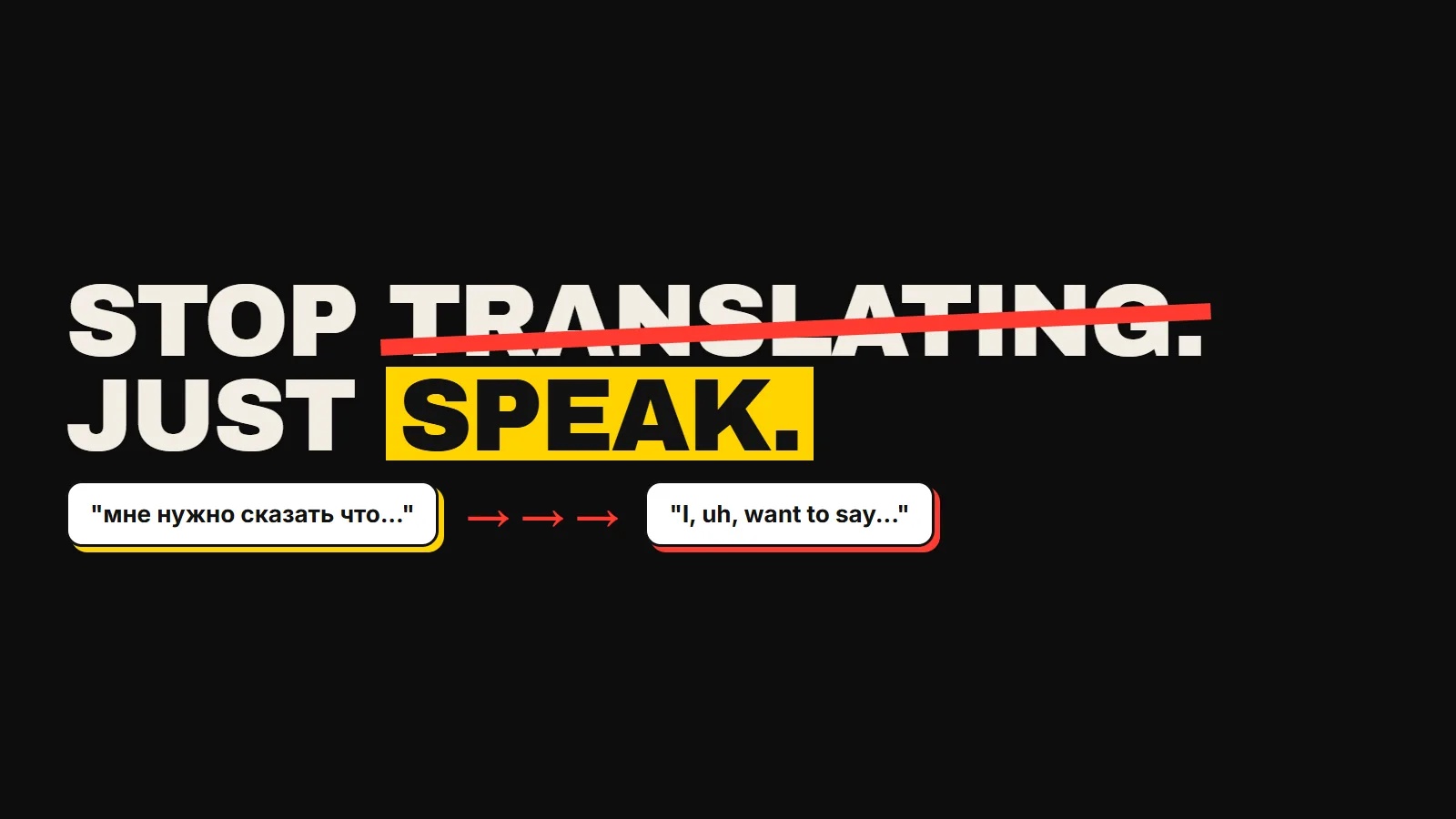
You're in a conversation in English. Someone asks you a question. Your brain formulates the answer in your native language, translates the key components, constructs an English sentence, checks it for errors, and then — if everything passes review — allows you to speak. By that point, three seconds have passed and the conversation has moved on without you.
This is mental translation. It's not a quirk or a personality trait. It's a processing stage — a normal intermediate step in language acquisition that sits between beginner and fluent. The problem is that it doesn't go away on its own. It goes away through deliberate practice of the specific behaviour you want to replace it with.
TLDR
- Mental translation is a stage, not a character flaw. Every learner goes through it. It does not spontaneously resolve.
- There are three processing stages: translation → chunking → direct thinking. You can move through them intentionally.
- Six specific exercises build direct English thinking. They're not complicated, but they require doing — not just understanding.
- The timeline is realistic: with daily practice, most learners notice meaningful reduction in translation lag within 6–10 weeks.
Why Your Brain Translates (And Why It Slows You Down)
When you learn a second language as an adult, your brain initially processes it through the first language. New vocabulary is stored with L1 (native language) anchors — you don't know the word "rain," you know the word that means дождь or lluvia or pluie in English. When you need to produce English, the activation pathway goes: concept → L1 word → L2 word → speech.
This is called controlled processing in cognitive linguistics. It's effortful, serial (one step at a time), and slow. The alternative is automatic processing — where L2 words activate directly from concepts, without the L1 intermediate step. This is what you observe in fluent speakers: they don't seem to "think" in their language before speaking, because the processing is fast enough to be effectively simultaneous with speech production.
The transition from controlled to automatic processing is called proceduralization — a term from Robert DeKeyser's research (2007) on practice in second language acquisition. Proceduralization happens through repeated, specific practice of the target behaviour — in this case, direct production of English without L1 translation.
The implication: the only way to stop translating is to practise not translating. Studying more grammar or expanding vocabulary doesn't directly address this — those improve knowledge, not processing speed.
The Three Stages of Language Processing
Understanding where you are makes the path forward clearer.
Stage 1: Full Translation Every sentence is formulated in your native language and translated before speaking. Lag is significant — 2–5 seconds on complex thoughts. Common at A1–B1. Reading and listening comprehension may be much stronger than speaking speed.
Stage 2: Chunk-Based Processing Frequent phrases and sentence structures activate automatically, while novel constructions still require translation. Partial translation lag — fast on familiar ground, slow on new territory. Common at B1–B2. The experience: easy phrases come out smoothly, then you freeze on something slightly different.
Stage 3: Direct English Thinking Concepts activate English words directly. L1 processing is minimal or absent. Speaking speed approaches thought speed. Common at B2–C1 with significant speaking practice. You notice this when you start dreaming in English, or when you instinctively reach for an English phrase before its L1 equivalent.
Most adult learners are somewhere in Stage 2 — mixed automatic and controlled processing. The exercises below are specifically designed to push Stage 2 processing toward Stage 3.
6 Ways to Train Direct English Thinking
Think About Your Day in English
Start your day with 5 minutes of English-medium thought. Not speaking aloud — just internal narration. "Today I need to finish the report. The meeting is at 3. I'm not sure about the agenda." Simple, functional, boring — and that's fine. The point is to activate English first, before your native language has a chance to claim the mental channel.
This feels unnatural at first because you're accustomed to internal monologue in your native language. The discomfort is the correct signal — you're rerouting a default. Do it daily. The novelty fades within a week.
Label Your Environment
When you're in a familiar space — your kitchen, office, commute route — look at objects and name them in English before your native language gets there. This sounds trivial. It's actually direct activation training: the visual input activates the English label without the L1 intermediate step.
Extend this to actions: "I'm making coffee. The water is boiling. I'm adding milk." Internal narration of what you're doing, in English, in real time. This builds the habit of thinking and naming simultaneously in English — the same process that underlies fluent speaking.
Stop Translating Sentences — Think in Chunks
The move from Stage 1 to Stage 2 thinking involves shifting from word-for-word translation to chunk-based production. Chunks are pre-formed phrases that activate as units: "by the way," "as far as I know," "the thing is," "I'm not sure if." These aren't translated — they're activated directly.
Start consciously building your chunk library. When you encounter a phrase that sounds natural in English and that you'd want to use, store it as a chunk — not by translating it, but by repeating it in context until it activates automatically. Think of it as adding pre-loaded responses that bypass the translation stage.
Speak Without Pausing for Translation
This is the core exercise and the one most learners resist. Set a timer for 2 minutes. Pick a topic — your morning, your opinion on something you read, your plans for the week. Speak in English without stopping, without pausing to find the exact word, without correcting errors.
If you don't know a word, describe it. If you say the wrong grammar, keep going. The objective is continuous English production, not accurate English production. The accuracy comes later; the fluency habit comes first.
The discomfort here is real — you will produce imperfect output. That's the mechanism. Imperfect output that keeps moving is more useful for proceduralization than perfect output that waits for approval.
Record and Review — Then Do It Again
After a speaking session (AI conversation, speaking club, language exchange), record 2 minutes of yourself. Listen back for the specific moments where you paused and translated. Note the trigger — was it a specific type of construction? Emotional vocabulary? Technical terms?
Then re-do the same type of session with specific attention to those triggers. This is deliberate practice in the sense DeKeyser describes — targeted repetition of the specific weakness, not general practice of speaking.
Use AI Conversation With Time Pressure
AI conversation apps that create genuine response pressure — Satur, Speak, Talkpal — are useful here for a specific reason: the scenario doesn't pause while you translate. The character continues, asks follow-ups, reacts to what you say. This real-time pressure is the environment that forces direct production rather than pre-formulated, translated speech.
The specific mechanism: when the translation lag causes a significant social cost (the conversation is moving on, the character is impatient, the moment is passing), the brain has an incentive to find faster pathways. Repeated exposure to this pressure, in low-stakes environments, trains faster L2 activation.
«Mental translation is not a sign of weak language ability. It's a sign of controlled processing — the expected intermediate stage. The specific practice that moves you out of it is speaking faster than you can translate.» — Satur, internal design notes, May 2026.
How Long Does It Take to Stop Translating?
There's no single honest number because it depends on how much direct speaking practice you do per day. The variable that matters most is not time elapsed but speaking hours logged under real-time pressure.
Rough estimates based on research on L2 proceduralization (DeKeyser, 2007):
- At 30 minutes per day of real-time speaking practice: noticeable reduction in translation lag within 6–10 weeks.
- At 60 minutes per day: faster — 3–5 weeks for meaningful reduction.
- At occasional practice (once or twice a week): months to years, with significant regression between sessions.
The key factor is regularity, not intensity. Daily 30-minute sessions outperform weekly 3-hour sessions for proceduralization. Consistency allows the automated pathways to consolidate rather than decay between practice instances.
FAQ
Is it normal to translate in your head when learning a language?
Yes. Mental translation (controlled processing) is the standard intermediate stage of language acquisition in adults. It occurs across all languages and all learners. It's not a sign of low ability — it's a sign of a stage. The stage resolves through specific practice.
How long does mental translation continue?
Without deliberate practice, some degree of translation may persist indefinitely even at advanced levels — typically for low-frequency vocabulary and complex novel constructions. With deliberate practice focused on direct production, most learners achieve predominantly automatic processing at B2–C1. Full automaticity for all domains typically requires extensive time-in-language.
Does immersion in an English-speaking country help stop translation?
Yes, significantly, because immersion provides high-frequency real-time pressure with social consequences — the same mechanism in an extreme form. However, the research on immersion (DeKeyser, 2007) shows that structured practice produces equivalent gains to immersion in shorter time periods when the practice is deliberately designed to address the target behaviour. Immersion without deliberate practice produces slower gains than structured practice with it.
Does thinking in English help improve speaking fluency?
Yes. The thinking-in-English habit is the internal version of the same neural pathway that direct speaking uses. Practising it during non-speaking moments (commute, daily routine, internal monologue) extends the practice window beyond formal speaking sessions. Most learners who report sudden fluency improvements were thinking in English significantly before the visible improvement appeared.
The translation stage is temporary. Every fluent speaker went through it. The difference is that fluent speakers crossed through it — not by studying their way out, but by speaking their way out.
Internal links:
- Passive vs Active English Learning — the distinction between consuming and producing language
- English Speaking Confidence — why translation lag feeds into confidence problems
- English Speaking Anxiety — the related anxiety dimension of the same problem
- How to Practise English Conversation Alone — methods that create the right pressure environment
External links:
- DeKeyser (2007): Practice in a Second Language (Cambridge University Press)
- Robert DeKeyser: Skill acquisition theory in L2 — research overview