How AI Language Tutors Work in 2026: The Technology Behind Speaking Practice Apps
AI language tutors aren't magic. They're LLMs, speech recognition, and feedback loops working together. Here's the tech behind apps like Speak, Talkpal, and Satur — plain English, no jargon.
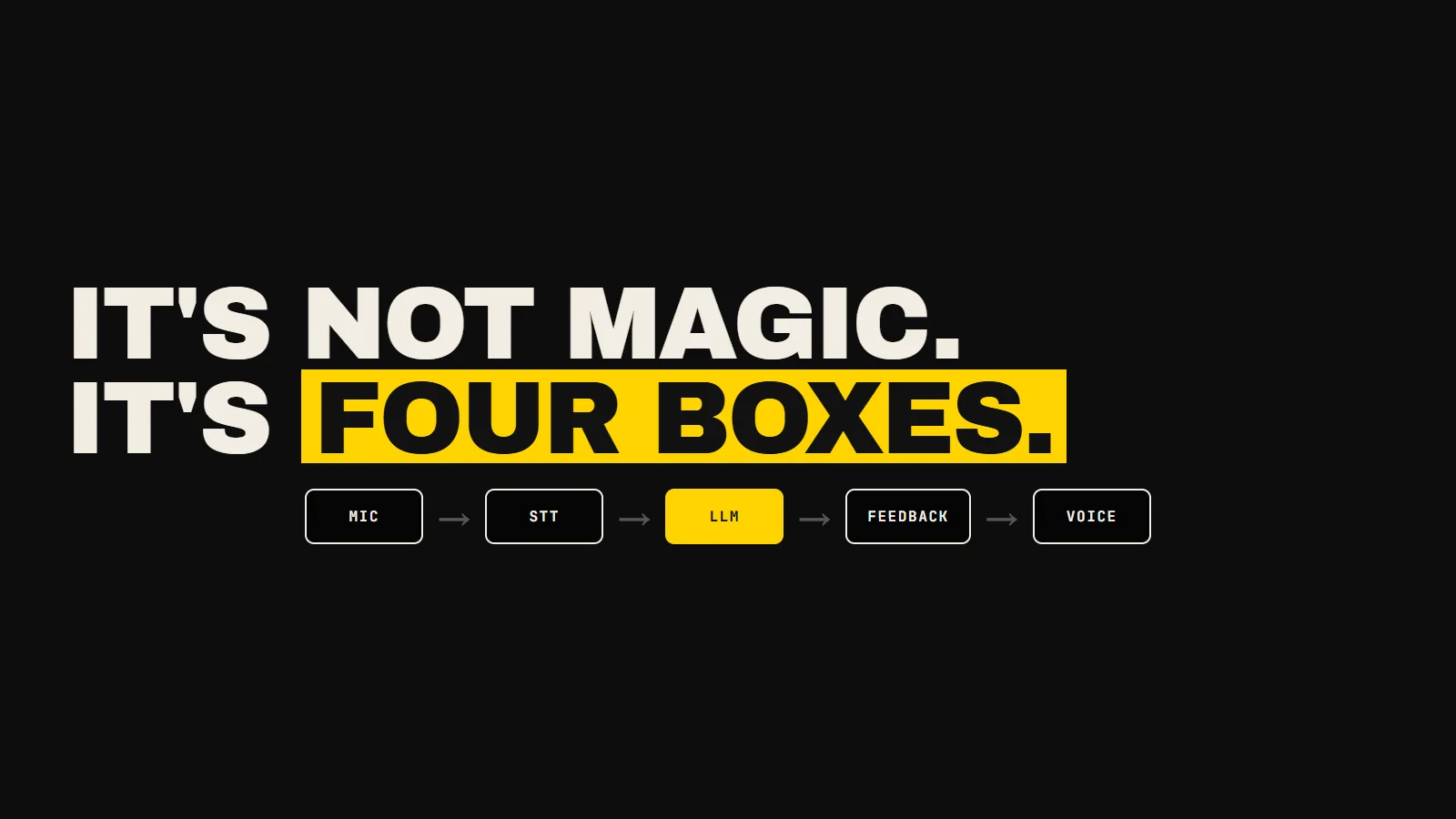
The marketing for AI language tutors tends toward the magical: «practise with an AI that feels human», «intelligent conversation partner», «your personal language coach available 24/7». None of this is wrong, exactly. It's also not very informative about what's actually happening when you speak into the microphone and something speaks back.
Here's the actual technology — three components, how they connect, what each one does well and badly, and how different apps make different choices within the same technical stack.
TLDR:
- AI language tutors use three core components: Speech-to-Text (STT), a Large Language Model (LLM), and a feedback/scoring engine.
- Each component has strengths and limitations — your experience varies based on how each app configures them.
- The biggest differentiator is not the underlying AI (most apps use similar models) but what the app optimises for: pronunciation accuracy, open-ended conversation, or scenario-based pressure.
- AI tutors are not going to replace human teachers for nuanced correction. They are better at availability, patience, and repetition.
Before AI Tutors: What "Talking to a Computer" Used to Mean
In the 1990s and early 2000s, language software meant CD-ROMs with pre-recorded native speakers, pattern-matching pronunciation checks, and branching dialogue trees. You picked option A or B. The computer compared your recording to a stored template. If you were close enough, you passed.
The limitation was obvious: the system could only respond to expected input. Say anything slightly off-script — a different phrasing, an unexpected question — and the system broke. «I'm sorry, I didn't understand that.»
What changed in the 2020s was not one thing but three things happening simultaneously: transformer-based LLMs became capable of open-ended dialogue, automatic speech recognition reached near-human accuracy for most accents, and text-to-speech synthesis became natural enough to not feel robotic. The combination made a genuinely new product category possible.
The Three Core Components
Speech-to-Text (STT) — Listening to You
When you speak into the microphone, the first step is converting audio into text. This is Speech-to-Text, also called automatic speech recognition (ASR).
The leading model behind many apps, including language tutors, is OpenAI's Whisper — an open-source model trained on 680,000 hours of multilingual audio. Whisper achieves word error rates competitive with professional transcription services on clean audio. Accented speech reduces accuracy, but by far less than older systems.
What STT does well: transcribing most speech accurately at reasonable audio quality, handling multiple accents, working in many languages simultaneously.
What STT does badly: it struggles with heavy accents outside the training distribution, background noise, and very fast speech. It also does not detect tone, hesitation, or the emotional content of speech — it transcribes words, not meaning.
Important: STT is not pronunciation scoring. Most STT systems produce text without rating how well you pronounced each word. Apps that offer pronunciation feedback (like ELSA Speak) layer additional phoneme-level analysis on top of basic STT. Most conversation-focused AI tutors do not do this.
Large Language Models (LLMs) — Understanding and Responding
Once STT converts your speech to text, the LLM processes it and generates a response.
The models underlying most AI language tutors are variations of GPT-4 or similar frontier models. These models are trained on vast text corpora and can generate coherent, contextually appropriate, stylistically varied text on almost any topic. They can maintain conversational context over multiple turns, adjust register (formal/informal), play a character, or respond to an unexpected question.
What LLMs do well: open-ended conversation, maintaining character and context across a session, generating natural-sounding responses, adapting to what the user said rather than picking from a pre-written tree.
What LLMs do badly: consistent factual accuracy (they can hallucinate), reliable pronunciation feedback (they don't hear you — they read a transcript), and any task that requires actual real-world perception.
The key design choice app makers face: what do you tell the LLM to optimise for? «Be a friendly conversation partner who corrects my English» produces a very different experience from «Be an aggressive character in a specific scenario who won't let me stop talking.» Same underlying model, different configuration.
According to the Satur team, their approach uses the LLM to build a character with a specific agenda — someone who argues, pushes back, and keeps the conversation moving. The goal is not to make the AI pleasant but to make silence uncomfortable. «We don't want the AI to be a good listener. We want it to be the kind of person who doesn't let you trail off.»
Feedback and Scoring Engine — How the App Decides What to Say
The third component is less visible but shapes your learning more than the other two. After you speak and the LLM responds, what does the app do with the information about your language use?
Different apps make radically different choices here:
ELSA Speak runs phoneme-level pronunciation analysis on your speech — it compares your sounds to a target pronunciation model and scores individual sounds. High investment in pronunciation feedback. Lower investment in conversational depth.
Speak (the app) prioritises pronunciation feedback combined with conversation. Their feedback is more granular than most apps — specific to sounds and rhythm, not just word-level transcription.
Talkpal focuses on open-ended conversation — less structured feedback, more extended dialogue. Good for extended speaking practice, less good for targeted correction.
Satur does not offer phoneme-level pronunciation feedback. The scoring engine is focused on conversational progress: did the user stay in the scenario, did they produce sufficient output, did they handle the pressure without bailing. The feedback is contextual to the scenario, not to individual sounds.
How Different Apps Use These Components
| App | STT | LLM use | Feedback focus | Best for |
|---|---|---|---|---|
| ELSA | Whisper + phoneme analysis | Limited conversation | Pronunciation scoring | Accent reduction, pronunciation |
| Speak | Whisper + pronunciation scoring | Moderate conversation | Pronunciation + fluency | Structured speaking improvement |
| Talkpal | Whisper | Open chat | Conversational feedback | Extended free speaking |
| Satur | Whisper | Scenario character | Conversational pressure | Real-time speaking under stakes |
| ChatGPT (unmodified) | N/A (text) | Open LLM | None | General conversation, but no speaking structure |
AI Tutor vs Human Tutor: Honest Comparison
Neither is universally better. They solve overlapping but distinct problems.
| Dimension | AI Tutor | Human Tutor |
|---|---|---|
| Availability | 24/7, any timezone | Scheduled, limited hours |
| Cost | ~$10–20/month | ~$15–50/hour |
| Patience | Infinite | Finite (professional, but human) |
| Cultural nuance | Limited | High (native speaker) |
| Complex correction | Inconsistent | High (if qualified) |
| Emotional support | None | Can provide |
| Accent correction | Varies by app | High (trained teacher) |
| Speaking pressure | High (scenarios) | Low (most tutors are accommodating) |
The most honest summary: AI tutors are better at frequency (practise every day, cheaply), consistency (same quality session 1 and session 100), and pressure (won't wait politely while you search for words). Human tutors are better at nuanced correction, cultural context, and complex grammar explanation.
For most learners, the question is not «which is better» but «which do I actually have access to regularly.»
What AI Tutors Still Can't Do
This section exists because the technology is genuinely impressive and genuinely limited. Both are true.
AI tutors cannot tell if you understood what was said. They work with text. If you nod or say «yeah» to something you didn't follow, the AI doesn't know. It proceeds as if you understood. A human tutor reads your expression.
AI tutors cannot reliably correct subtle grammar errors. LLMs sometimes produce corrections themselves that are wrong. They're better at obvious errors than at the grammar point that native speakers break deliberately for effect.
AI tutors cannot replace cultural immersion. The LLM knows about culture in the abstract — it can tell you that «I'm fine» is a non-answer in British culture. It cannot read the room at a dinner party.
AI tutors cannot guarantee factual accuracy in conversation. If you ask the AI something specific and it generates a plausible-sounding but wrong answer, you may not know. For language practice this is usually harmless. For language learning about content (history, science, law) — verify independently.
Where Is the Technology Going?
Three directions that are already partly here and will be mainstream within two years:
Multimodal AI. Models that process audio directly without STT as a separate step. GPT-4o already does this in limited contexts. When this matures, AI tutors will hear tone, hesitation, and emotional content — not just transcribe words.
Personalised feedback loops. Apps are beginning to track patterns across sessions — which sounds you consistently miss, which grammar constructions you avoid, which topics make you switch to simpler vocabulary. The feedback becomes cumulative, not just per-session.
Emotion detection. Detecting anxiety, confidence, frustration from voice patterns. Relevant for language anxiety specifically — AI tutors could adjust pressure levels dynamically based on detected stress signals.
FAQ
Does Duolingo use AI?
Duolingo uses AI in multiple ways: for adaptive lesson sequencing, personalised content selection, and increasingly for conversation features (Duolingo Max's Roleplay feature uses GPT-4). Traditional Duolingo lessons are not AI-conversational — they're algorithmically sequenced from a pre-built lesson library.
Is it safe to talk to an AI language tutor?
Yes in the practical sense — speaking to an AI is not dangerous. Privacy considerations apply: your speech is processed by the app's servers. Check the app's privacy policy before sharing sensitive personal information in conversation.
How is an AI tutor different from ChatGPT?
ChatGPT is a general-purpose conversational AI. It will have a conversation with you in English, but it has no structure around language learning — no scenarios, no feedback on your English, no accountability if you bail on the conversation. AI language tutors are built specifically around speaking practice: they have structured scenarios, feedback engines, and design choices aimed at making you produce language, not just consume it.
How does AI recognise my accent?
Through STT models like Whisper, which are trained on audio from many accents and languages. Accuracy varies by accent — accents well-represented in training data perform better. For non-standard or regional accents, accuracy can be lower. Apps that have invested in accent-specific training data perform better on specific accents.
Links
External:
- OpenAI Whisper: github.com/openai/whisper — open-source STT model documentation
- Rankin, T. et al.: Computer Assisted Language Learning — CALICO Journal (published research on AI in language learning)
- MIT Schwarzman College of Computing: AI in Education research (publicly available summaries)