Satur vs Talkpal: Which AI Conversation Partner Is Worth Your Money?
Talkpal lets you chat about anything. Satur gives you a scenario and a character that won't let you off the hook. We compare them honestly — price, features, what each does best.
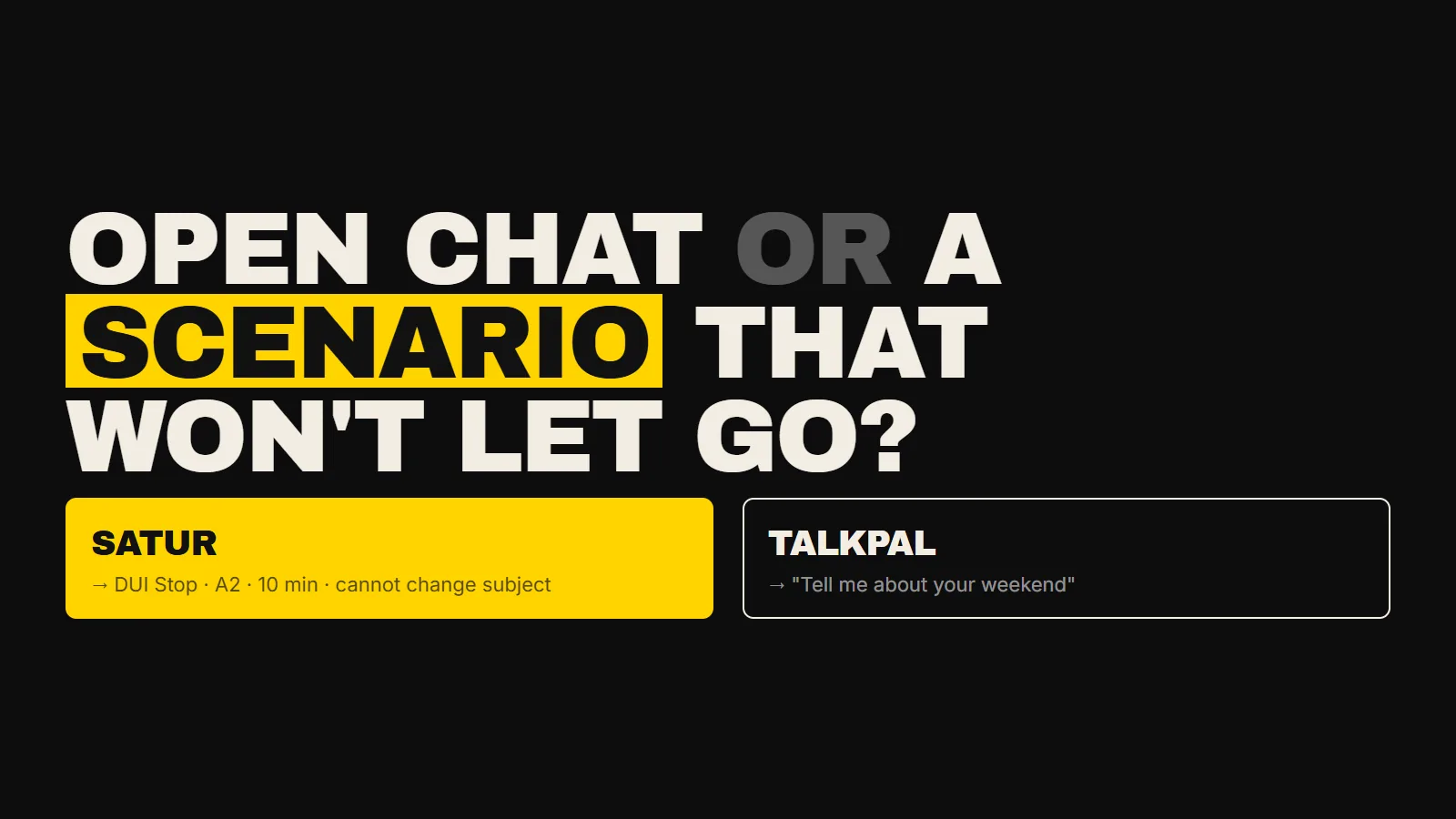
Talkpal and Satur are both AI conversation partners for English practice. They cost roughly the same, run on your phone, and both promise to make you speak. The similarities end there.
Talkpal gives you an open conversational interface — you pick the topic, the AI responds, the conversation goes wherever you take it. Satur gives you a scenario, a character with an agenda, and puts you in a situation that doesn't resolve until you talk your way out. One is a blank page. The other is a stage.
Neither is universally better. The right choice depends on what your speaking practice actually needs.
TLDR
- Talkpal = open-ended AI chat. You control the topic, the pace, the direction. Great if you have something specific to practice or want a low-pressure daily habit.
- Satur = scenario-driven AI conversation. A character, a conflict, a pressure to resolve. Great if you keep chickening out of hard moments in real conversation.
- Price is close. Both are in the $8–15/month range depending on plan.
- Choose Talkpal if you want flexibility and already have discipline. Choose Satur if you need structure and a push.
Two Different Approaches to AI Conversation
The philosophical difference matters because it determines what happens when you open the app.
With Talkpal, you arrive at a blank interface. You can say anything — ask about travel, practice a job interview, just chat. The AI adapts. For learners who know exactly what they want to practice, this is efficient. For learners who freeze up deciding where to start, this is another way to spend 10 minutes not actually speaking.
With Satur, you arrive at a mission. Today's scenario might be a neighbour dispute over parking, a client who wants a refund you can't give, or a bar where someone's been waiting for your answer for too long. The AI plays the other person — with a specific personality, specific goals, and no intention of letting you off easy. You don't decide what to practice. The situation decides.
This isn't better or worse by default. It's a different model of what practice looks like.
Comparison Table
| Feature | Talkpal | Satur |
|---|---|---|
| Price (monthly) | ~$8–15/month | 1 469 ₽/month (~$15) |
| Free trial | Yes, limited | Yes, no credit card required |
| Conversation model | Open chat, user-directed | Scenario-based, AI-directed |
| Character/persona | Adaptive AI, no fixed persona | Character with agenda and personality |
| Scenario library | Not applicable | 127+ scenarios across themes |
| Dirty/adult mode | No | Yes (Dirty mode 18+) |
| Platform | iOS, Android, web | iOS, Android |
| Best for | Flexible daily practice, specific topic drills | Pressure-training, breaking through anxiety |
Pricing and feature data: publicly available pages, May 2026.
Talkpal — What Works and What Doesn't
What works:
Talkpal's open conversation model is genuinely useful for drilling specific vocabulary domains. If you have a business presentation next week, you can role-play it. If you want to practice talking about your work, you can steer there immediately. The AI doesn't resist or redirect — it follows.
This flexibility makes Talkpal a strong option for learners who already have discipline and a specific goal. It's also lower-stakes — conversations can be casual, slow, or exploratory without a sense that you're failing a mission.
What doesn't work:
The open-ended structure is exactly its limitation for learners who lack discipline or direction. Without a prompt to respond to, many users spend the practice session warm-up, not actually practicing under pressure. The AI is too polite. Real conversations aren't polite — they're interrupted, they're unclear, they push back.
Talkpal doesn't replicate that pressure. If you already freeze up in real English conversations, a blank page where the AI is waiting for you to start is unlikely to fix that.
Who it's for: Learners with a specific topic in mind, existing discipline, and lower anxiety about open-ended speaking.
Satur — What Works and What Doesn't
What works:
The scenario model removes one of the most common failure modes of speaking practice: the paralysis of deciding what to say. In Satur, the situation decides. The AI plays a character — someone who wants something from you, who responds to what you actually say, who won't let you deflect indefinitely.
The pressure is the point. Speaking anxiety in real life doesn't come from bad grammar — it comes from high-stakes moments where something needs to be said. Satur replicates this structurally, in a low-consequences environment.
The Dirty mode (18+) is a differentiator no other speaking app currently offers. For learners who want to practice colloquial, unfiltered English, this is the only structured environment that allows it.
What doesn't work:
Satur has real limitations. It does not offer pronunciation feedback the way ELSA does. If your primary concern is your accent or phoneme accuracy, Satur isn't designed for that. It doesn't have a live human tutor option — if you want a real person on the other end, Cambly or Preply are better suited. The scenario library, while large (127+), isn't infinitely customizable on demand — Talkpal gives you more real-time topic flexibility.
The structured scenario model also means you don't practice open-ended self-directed conversation as directly. Both skills matter.
Who it's for: Learners who know they can speak technically but freeze under pressure. People who need structure to actually open their mouth.
Where Satur Falls Short
This section exists because comparison articles that only highlight one product's strengths are advertising, not analysis.
- No pronunciation feedback. ELSA Speak is significantly better here. If you want phoneme-level coaching, Satur doesn't do that.
- No live human tutor. Cambly and Preply offer real human interaction. That's irreplaceable for some learners.
- Less language coverage. Talkpal and Duolingo support more languages. Satur is English-focused.
- Scenario dependency. If you don't want to engage with a scenario premise, the app doesn't work the way it's designed. Talkpal is more adaptable to mood.
- Platform availability. No desktop web app confirmed at time of writing — primarily mobile.
The Research Case for Structured vs Unstructured Practice
There's a body of research in second language acquisition on the relative value of structured and unstructured speaking practice. It doesn't produce a clean winner — it produces a nuanced answer that maps well onto the Talkpal vs Satur distinction.
Unstructured practice (open-ended conversation, topic-directed chatting) builds conversational range — the ability to navigate different subjects, respond to unexpected direction changes, and adapt. Research on lexical development suggests that exposure to varied topics builds broader vocabulary networks. Talkpal's open model supports this.
Structured task-based practice (scenarios with defined goals, constraints, and characters) builds specific types of fluency: task-completion under pressure, repair strategies (what to do when you don't know a word), and negotiation of meaning. A 2001 meta-analysis by Norris and Ortega on form-focused instruction found that task-based practice produced stronger outcomes for speaking fluency than unstructured exposure, particularly for intermediate learners. Satur's model maps directly onto task-based language teaching (TBLT) — a well-validated methodology.
For most B1–B2 learners, the recommendation would be: start with structured task-based practice to build pressure tolerance, then add open-ended practice to build range. In Talkpal/Satur terms: Satur first to fix the freezing, Talkpal second to extend the range.
Price and Value Comparison
Both apps sit in the same price tier — roughly $8–15/month depending on plan and region. For the Russian market, Satur is priced at 1 469 ₽/month with a first-month discount, and does not require a credit card to try.
For context: one hour with a human tutor on Preply or Cambly typically costs $15–25. Both Satur and Talkpal are cheaper than a single tutor session per month.
The value comparison isn't price — it's whether the format actually creates speaking practice that transfers to real conversations. That depends on the learner, not the price tag.
One more angle: daily consistency. Both apps are designed for short daily sessions — 10–20 minutes produces better outcomes than a single weekly hour for speaking development, according to most research on language acquisition spaced practice. If Talkpal's blank page makes you procrastinate and Satur's scenario gets you talking immediately, the value difference is time-in-practice, not features. Use the one you actually open.
Which One Should You Choose?
Choose Talkpal if:
- You have a specific topic, domain, or scenario you want to drill
- You prefer low-pressure, flexible conversation without a structured mission
- You're practicing for something specific (presentation, trip, meeting)
- You already have speaking discipline and just need a conversational partner
Choose Satur if:
- You know you can form sentences but avoid speaking under pressure
- You want structured practice that pushes back rather than accommodates
- You're interested in colloquial or adult-register English (Dirty mode)
- You tend to cancel or procrastinate on speaking practice — the mission format forces commitment
Can you use both? Yes. Talkpal for daily low-pressure reps, Satur for deliberate pressure training. They don't compete for exactly the same use case.
FAQ
Which is cheaper, Satur or Talkpal?
They're in the same price range — roughly $8–15/month. Satur charges 1 469 ₽/month in Russia with a first-month discount. Talkpal offers tiered plans depending on features. Check current pricing on each product's website for exact numbers, which may have changed since May 2026.
Is Talkpal available in Russian?
Talkpal supports multiple interface languages. It offers conversation in English as the practice language regardless of your device language. Check the app for the current language interface list.
Can I use both apps?
Yes — they serve different use cases. Talkpal for flexible self-directed practice, Satur for scenario-based pressure training. If budget allows, using both isn't redundant.
Which is better for beginners?
Talkpal's open conversation model may be less overwhelming for absolute beginners who want to ease in. Satur's scenario format can be intense for very early learners — the pressure is by design. If you're at A1-A2, starting with Talkpal and adding Satur at B1 might be a reasonable sequence.
Does Satur work without internet?
Satur is an AI-powered app — it requires internet connection for real-time conversation processing. Offline mode is not confirmed as of May 2026.
Talkpal is a good app. Satur is a different kind of good. If you keep postponing speaking practice because you're not sure where to start — the blank page won't help. Try the scenario instead.
Internal links:
- Satur vs Speak App — a comparison with Speak, the other major AI speaking app
- Best AI Apps to Practice Speaking English — full 4-way comparison including ELSA
- What Is an AI Conversation Partner? — how AI speaking apps work vs chatbots and tutors
External links:
- Talkpal official site — current pricing and features