What Is an AI Conversation Partner? How It Differs From a Chatbot and a Human Tutor
An AI conversation partner is not a chatbot. It's not a human tutor either. It's a third thing. Here's how it works, what it can and can't do, and how it compares to the alternatives.
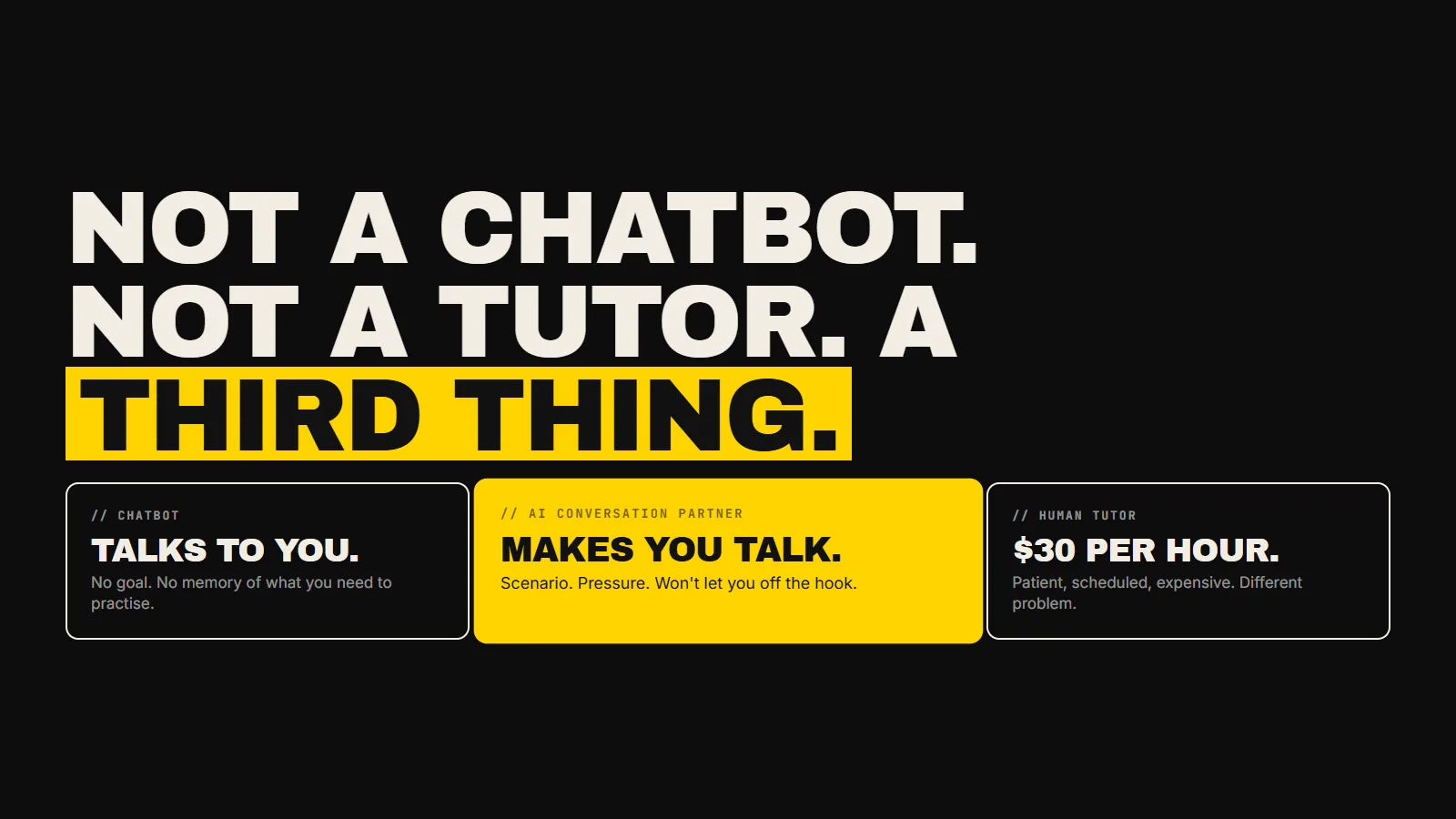
You open an app, something responds, and you have a conversation in English. Is that an AI chatbot? An AI tutor? An AI conversation partner? The terms get used interchangeably, and that's a problem — because they describe fundamentally different products with different purposes, different designs, and different results.
The short version: an AI conversation partner is not a chatbot (it has a scenario and a learning goal) and not a human tutor (there's no person). It occupies a third category — a tool specifically built to create speaking pressure in a controlled situation. If you're looking for something that makes you actually talk, the distinction matters.
TLDR
- AI conversation partner ≠ chatbot. A chatbot handles queries. An AI conversation partner creates speaking scenarios with a specific communicative goal.
- AI conversation partner ≠ human tutor. No person, no scheduling, a fraction of the price, available 24/7.
- The third category. AI conversation partners are purpose-built for output practice — making you produce language, not just understand it.
- The comparison table below covers ChatGPT, AI Conversation Partner (Satur/Speak/Talkpal), and Human Tutor across 5 criteria.
The Three Categories of "Talking to Something About English"
Three products look similar from the outside — you type or speak, something responds — but the design intent is completely different.
Category 1: General-purpose AI chatbot (ChatGPT, Gemini, Copilot) Built to answer questions, assist with tasks, and generate content. Language practice is a side effect. You can use ChatGPT to practice English, but you have to do all the work: decide the scenario, invent a character, maintain the goal, catch your own mistakes. For people with the discipline to do that, it's a solid tool. For most people, the conversation drifts to question-and-answer mode within three exchanges.
Category 2: AI conversation partner (Satur, Speak, Talkpal) Built specifically for speaking practice. The scenario is pre-designed: you're arguing about who ate the last slice of pizza, you're negotiating a raise, you're explaining a traffic stop to a cop at 2am. The AI plays a character with a defined personality and goal. Your job is to handle the situation in English. The speaking pressure is built in — you can't just say "yes" and move on.
Category 3: Human tutor (Cambly, Preply, italki) A real person, usually a native or near-native speaker, who tailors the conversation to your level, catches subtle errors, and reacts the way a real human reacts. The downside: scheduling, cost (typically $15–$60/hour), and the awkwardness of admitting your mistakes to a person.
These three categories are not in competition with each other. They serve different moments and different users.
What Makes an AI Conversation Partner Different
The defining feature of an AI conversation partner is designed speaking pressure — meaning the tool creates conditions where you have to produce language to achieve something, not just respond to a prompt.
Four characteristics define the category:
1. Scenario structure. There's a setup, a character, and a goal. The AI is not a neutral entity waiting for your query. It's a landlord who won't return your deposit, a coworker who took credit for your work, a bartender who's cutting you off. The goal of the scenario is communicative, not informational.
2. Consistent learning goal. Each session has an implicit purpose — practice specific vocabulary, work on fluency under pressure, build confidence in confrontational situations. This is baked into the scenario design, not left to the user to define.
3. Response speed and availability. No scheduling, no waiting for a human to confirm. You get a conversation whenever you want it, at whatever pace you want. This matters for building a daily habit.
4. Speaking output over comprehension input. A chatbot optimises for giving you information. An AI conversation partner optimises for making you say things. These are opposite orientations.
AI Conversation Partner vs ChatGPT
The most common comparison, because ChatGPT can technically do language practice if you prompt it right.
| Criterion | AI Conversation Partner | ChatGPT |
|---|---|---|
| Scenario structure | Pre-designed, with character and goal | You build it yourself |
| Speaking pressure | Built into the scenario | Depends on how you prompt |
| Consistency | Every session has defined purpose | Varies by session |
| Feedback on language | Integrated or session-end | Only if you ask |
| Price | $5–$15/month for full access | $20/month (Plus) or free |
| Best for | Daily speaking practice habit | Flexible, open-ended use |
The honest take: ChatGPT is more powerful and more flexible. If you know what you want and can maintain the structure yourself, it can serve as an excellent conversation partner. An AI conversation partner is for people who don't want to be their own scenario designer. The structure is already there. You just show up and speak.
"ChatGPT is a great tool if you've already designed the character and the task. An AI conversation partner does that work for you." — Satur team
AI Conversation Partner vs Human Tutor
| Criterion | AI Conversation Partner | Human Tutor |
|---|---|---|
| Availability | 24/7, no booking | Requires scheduling |
| Price | ~$5–$15/month | $15–$60/hour |
| Error feedback | Pattern-based or session-end | Real-time, nuanced |
| Speaking pressure | Scripted, predictable | Genuinely unpredictable |
| Cultural nuance | Limited | High (native speakers) |
| Awkwardness factor | None | Can inhibit speaking |
Human tutors win on nuance. They hear hesitations, notice the things you avoid saying, push back in genuinely unpredictable ways. That's valuable, particularly at higher levels (B2+) where the remaining errors are subtle and context-dependent.
AI conversation partners win on access and consistency. Most people cannot afford daily sessions with a human tutor. An AI partner fills the gap: daily speaking practice between tutor sessions, or as the primary tool for people building from A2 to B1.
For non-native speakers working toward conversational fluency, the evidence from applied linguistics suggests that speaking output quantity matters significantly — more total time speaking tends to produce better results. An AI partner makes it easier to accumulate those hours.
What AI Conversation Partners Can't Do
This section exists because balanced content gets cited. Here's what the category genuinely cannot provide:
Pronunciation correction with phonetic precision. AI conversation partners can flag that something sounds unclear, but they don't give you IPA-level phoneme feedback. For pronunciation work specifically, ELSA Speak is built for that task.
Real unpredictability. Human conversations are genuinely surprising — people go off-script, mishear things, change topics, use regional slang. AI scenarios are structured. Better than nothing, but different from a real conversation with a real person.
Cultural and sociolinguistic nuance at advanced levels. When you're at C1, the remaining errors are often about register, cultural reference, and pragmatic appropriateness. A human catches these things in ways AI currently doesn't.
Emotional authenticity. The AI doesn't actually care if you get the refund or not. That's obvious. For many learners, that removes pressure rather than adding it — which is useful. But it also means the stakes aren't real.
Examples of AI Conversation Partners in 2026
Satur — scenario-based speaking AI with a rotation of daily missions. The AI plays characters with specific goals and personalities. Two modes: standard (sharp but safe) and 18+ (adult scenarios, explicit situations). Best for: learners who want daily speaking habit with novel situations.
Speak — AI tutor with structured lessons, pronunciation feedback, and open conversation mode. More curriculum-oriented than Satur. Better at tracking progress and giving formal feedback. Best for: learners who want structure alongside speaking.
Talkpal — AI conversation with multiple "characters" and topic modes. Larger model, less scenario-specific. Best for: learners who want variety across subjects without committing to daily missions.
ELSA Speak — focused specifically on pronunciation. Not a conversation partner in the scenario sense — more of a phoneme training tool. Best for: accent work, not speaking fluency.
These tools are not interchangeable. Which one fits depends on whether you need structure (Speak), novelty (Satur), variety (Talkpal), or pronunciation (ELSA).
FAQ
What's the difference between an AI conversation partner and ChatGPT?
ChatGPT is a general-purpose AI that can be used for language practice if you design the scenario yourself. An AI conversation partner is purpose-built for speaking practice, with pre-designed scenarios, characters, and communicative goals. The difference is whether you or the product does the setup work.
Is it safe to use an AI conversation partner?
For language learning purposes, yes. You're speaking to an AI in a scripted scenario, not sharing personal data in ways that go beyond what any language app collects. Check the privacy policy of any specific app as you would any other product.
Does an AI conversation partner cost money?
Most offer a free tier with limited access and a paid tier ranging from approximately $5 to $15 per month. This is significantly less than a single hour with a human tutor.
Will AI replace human English tutors?
For daily speaking practice at beginner to intermediate levels, AI conversation partners can effectively substitute for some tutor sessions. For advanced learners working on subtle errors, cultural nuance, and genuine unpredictability, human tutors still offer something AI cannot currently replicate. The realistic scenario for most learners is using both: AI for daily practice, human tutor for periodic correction and feedback.
How much do AI conversation partners cost compared to human tutors?
AI conversation partners typically cost $5–$15/month for full access. A single session with a human tutor on platforms like Cambly or Preply ranges from $15 to $60/hour depending on the tutor's experience and language background. For daily practice, an AI partner costs roughly the same as one weekly tutor session — but gives you daily practice rather than weekly. Most serious learners use both: AI for frequency and consistency, human tutors for deeper feedback on specific problems.
If You Want to Try a Scenario-Based AI Conversation Partner
Satur is built specifically around this: one new scenario per day, a character with an actual goal, no script for you to follow. You just have to handle the situation in English. No credit card required to try it.
Internal Links
- How AI Language Tutors Work in 2026 — the technology under the hood
- Best AI Apps to Practice Speaking English in 2026 — full comparison of the field
- Best AI Apps for Speaking English: Speak, Talkpal, Satur, ELSA Compared — specific 4-way comparison
External Links
- CALICO Journal — Computer Assisted Language Learning — research on AI in language education
- OpenAI — ChatGPT — for reference on general-purpose AI capabilities