How to Get Speaking Practice Without a Native Speaker (Or Anyone At All)
You don't have a native English-speaking friend. You don't live in an English-speaking country. You still need to practise speaking. Here's how — without any of that.
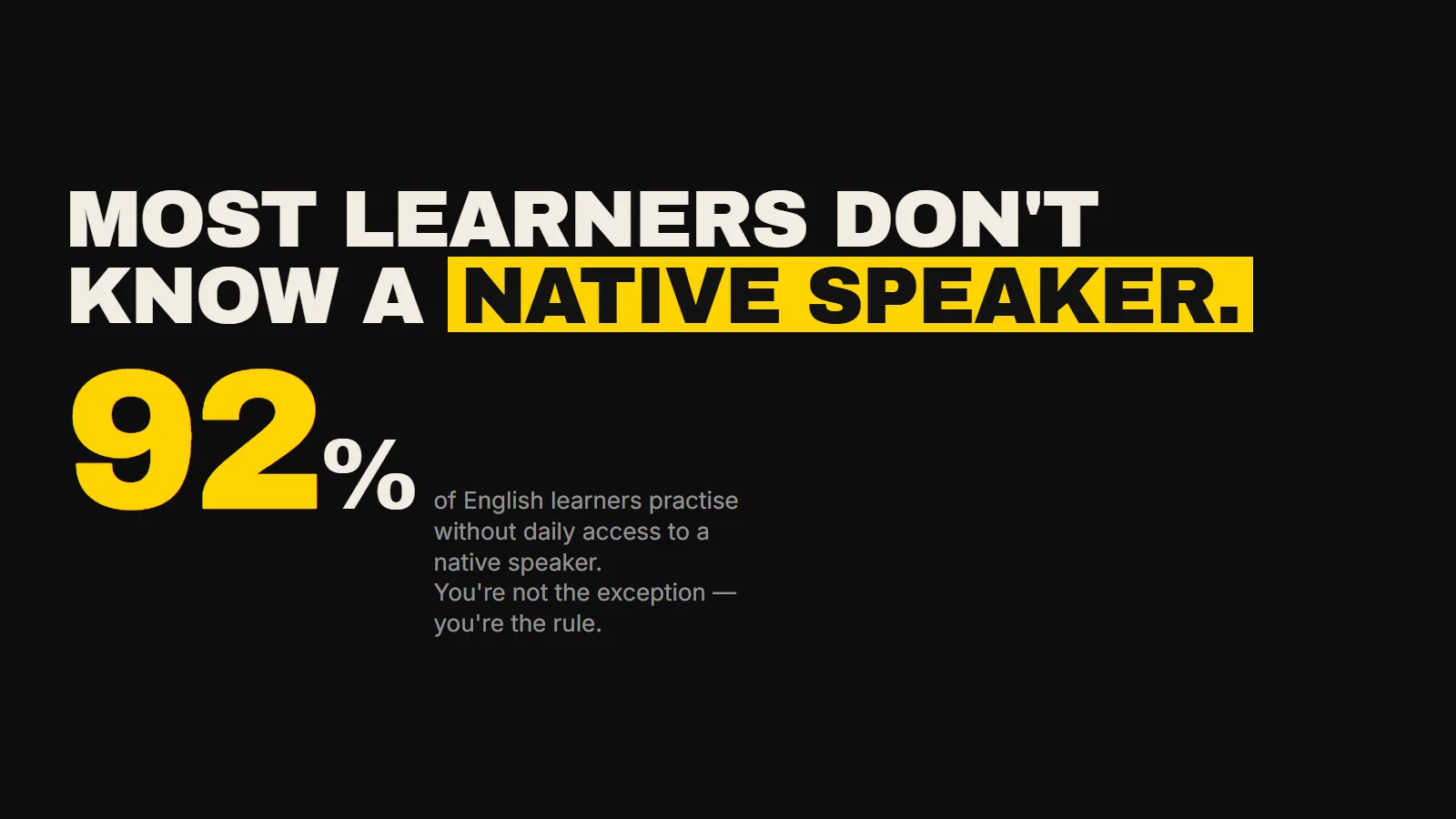
Most people learning English don't live in the UK or the US. They don't have a native English-speaking partner, a bilingual workplace, or a language exchange friend who shows up reliably every Tuesday. They have an internet connection, some motivation, and the persistent feeling that they need to talk to a real native speaker before they can really practise.
That feeling is wrong — and it's costing people months of progress.
The Eurobarometer 2024 survey found that self-directed digital language learning is now the most common method for adult language improvement in the EU — more common than classroom instruction, private tuition, or language exchange. The majority of people improving their English are doing it without a native speaker in the room.
Here's what actually works.
TLDR
- The native speaker requirement is a myth. Research consistently shows that non-native-to-non-native interaction is effective for language development — sometimes more so, because the anxiety is lower.
- Five methods work without a native speaker: AI conversation apps, language exchange (non-native to non-native), shadowing with output, self-recording, and online speaking clubs.
- AI conversation is the only method with 24/7 availability and consistent pressure — which is why it's the highest-frequency option for most adult learners.
- The goal is regular output under some pressure, not perfect input from a native speaker.
The "Native Speaker" Myth
The idea that you need a native speaker to practise English properly is based on a valid intuition (exposure to correct, natural English is valuable) taken too far (therefore only native speakers are useful).
The evidence doesn't support the extreme version.
Research by researchers at the University of Edinburgh and elsewhere has found that learners who practice primarily with other non-native speakers can develop strong oral fluency — in some studies showing faster acquisition rates because anxiety is lower when both participants are equally imperfect. The Netherlands, Denmark, and Sweden consistently produce some of the highest non-native English fluency scores in the world. Their education systems emphasise output practice, not native speaker access.
What native speakers provide that's genuinely valuable: authentic input of natural spoken English, exposure to colloquialisms and regional variation, and a high-stakes interlocutor who sets the terms of conversation rather than accommodating your level.
What native speakers don't uniquely provide: the neurological practice of producing English under pressure. That happens when you speak — with anyone, or even with an AI.
5 Ways to Practise Speaking Without a Native Speaker
AI Conversation Apps
The most significant development for speaking practice in the last three years is the arrival of AI conversation partners that can hold extended, pressure-creating conversations in English. The best of these — Speak, Talkpal, Satur — do something earlier text-based apps couldn't: they create genuine response pressure.
When an AI character is mid-argument with you about who ate the last slice of pizza, and they're not going to accept "I don't know" as an answer, that's real speaking pressure. Not as high as a job interview or a first date, but structurally similar to what makes real conversation hard: you have to produce language in real time, without a dictionary, in response to something you didn't expect.
Best for: Daily practice, high-frequency sessions, building output fluency over time. Limitation: AI cannot catch all the subtle errors a skilled human tutor would catch. It doesn't teach you about English — it makes you practise English.
Language Exchange (Non-Native to Non-Native)
Apps like Tandem and HelloTalk connect learners who want to exchange languages. A Spanish speaker learning English connects with an English speaker learning Spanish, and they split the session: half in each language.
The non-native-to-non-native interaction objection (both people make errors, neither can correct the other reliably) is partially valid but overblown. Both participants have strong motivation. Both are practising output. The feedback loop is imperfect, but the speaking practice is real.
Best for: Building conversation habit, getting regular real-human interaction, language motivation through social connection. Limitation: Scheduling reliability varies. Partner matching can take time. Not always available on demand.
Shadowing With Output Tasks
Shadowing — listening to a native speaker and speaking along simultaneously — is a technique with solid research support for pronunciation and naturalness. The standard version is passive-ish: you're mimicking, not generating.
The upgraded version adds an output task: shadow a clip, then immediately respond to it as if in a conversation. If you shadowed a news anchor describing a controversy, you respond with your opinion. If you shadowed a dialogue, you continue the scene. This forces genuine language production off the back of strong input.
Best for: Pronunciation improvement, rhythm and intonation, transitions from passive to active practice. Limitation: Requires discipline to design the output task yourself. Easy to slip back into passive shadowing only.
Recording Yourself
A microphone, a topic, and the instruction to speak for 2 minutes without stopping. This is more difficult than it sounds for most B1 learners — the pressure of filling silence alone is useful practice.
The more structured version: pick a topic, speak for 2 minutes, listen back, note the specific points where you stumbled or went to your native language, re-record. This is self-coaching without a partner.
Best for: Building monologue fluency, preparing for presentations or speeches, identifying your specific weaknesses. Limitation: No interaction — you only practise your output, not response formation.
Online Speaking Clubs
Platforms like Toastmasters International run English-language clubs globally. Many are free or low-cost. The audience is primarily non-native English speakers in global clubs — which is a feature, not a bug. You're in a structured environment that requires you to speak, to an audience, in English.
There are also informal speaking clubs via Discord servers, language-learning subreddits, and Meetup groups. These vary in quality but the basic mechanic — structured public speaking practice — is the same.
Best for: Developing public speaking confidence, structured speaking with a group, accountability. Limitation: Fixed scheduling, finding a good club can take time, quality varies.
Why Non-Native to Non-Native Practice Works
The anxiety argument is not trivial. Research by MacIntyre & Gardner (1994) established the concept of language anxiety — the specific fear response that activates when producing a second language, distinct from general anxiety. Non-native-to-non-native interaction reduces this anxiety because the perceived judgment stakes are lower: neither participant is the authority on the language.
A study published in CALICO Journal examined learner oral fluency development in native-to-non-native versus non-native-to-non-native conversation pairs. Non-native dyads showed comparable or better fluency gains in several metrics — attributed primarily to reduced anxiety and higher speaking frequency (non-native pairs tended to practise more often because the scheduling burden was lower and the interaction felt less high-stakes).
This doesn't mean native speaker interaction has no value. It means the all-or-nothing framing — native speaker or nothing — is not supported by evidence.
How AI Changes the Equation
The specific value of AI for speaking practice is not that it replaces native speakers. It's that it removes the scheduling constraint entirely.
A language exchange partner is available when they're available. A tutor is available when you've booked. A speaking club meets on Tuesdays. An AI conversation partner is available at 6:47 AM on a Wednesday when you have 15 minutes before work and a vague sense that you should practise today.
The second value is consistency of challenge. A good AI conversation partner doesn't let you off easy because it likes you. It doesn't lower its standards because you seem tired. The scenario continues until you resolve it — which creates a reliable form of pressure that's hard to replicate with a human who's also learning and also being polite.
«A native speaker is not required for fluency. What's required is regular speaking practice under real pressure. The medium matters less than the frequency.» — Satur, internal design notes, May 2026.
FAQ
Do you need a native speaker to become fluent?
No. Fluency is developed through regular output practice — producing language, not just consuming it. Non-native to non-native interaction, AI conversation, and self-recording all contribute to fluency. Native speakers are valuable input sources but not prerequisites.
What's better for English practice — AI or language exchange?
For daily frequency, AI wins because there's no scheduling. For human social motivation and natural interaction patterns, language exchange has advantages. The optimal combination is AI for daily practice, language exchange for weekly human interaction.
Does talking to another non-native speaker help your English?
Yes. Research consistently shows speaking practice with non-native partners develops fluency comparably to native-partner practice in most oral production metrics. The anxiety reduction often leads to higher practice frequency, which outweighs the accuracy advantage of native-partner correction.
How do I find a language exchange partner?
Tandem (app), HelloTalk (app), italki community tutors, Reddit r/language_exchange, and Meetup groups are the most reliable sources. Expect some trial and error before finding a consistent partner — scheduling and motivation mismatch are the most common drop-off reasons.
How do I know if my English is improving without a native speaker to tell me?
Three reliable self-assessment methods: (1) Record yourself speaking on the same topic once a month and compare. Improvement in retrieval speed and pause frequency is audible. (2) Track how often you translate in your head before speaking — declining frequency is a fluency indicator. (3) Notice whether non-native speakers you interact with understand you more easily over time — this is a real-world intelligibility check that doesn't require native speaker validation. Progress without native speaker feedback is measurable; it just requires you to build the measurement habit yourself.
The native speaker myth survives because it gives a clean excuse: "I can't practise properly yet because I don't have a native speaker." The methods above remove the excuse. Regular output practice — whatever form it takes — is what builds speaking fluency.
Internal links:
- How to Practise English Conversation Alone — companion article on solo practice methods
- English Speaking Anxiety: Why It Happens — the psychology of speaking fear
- What Is an AI Conversation Partner? — how AI speaking apps differ from chatbots and tutors
External links:
- Eurobarometer 2024: Europeans and Languages
- MacIntyre & Gardner (1994): Language anxiety research (JSTOR or Google Scholar)